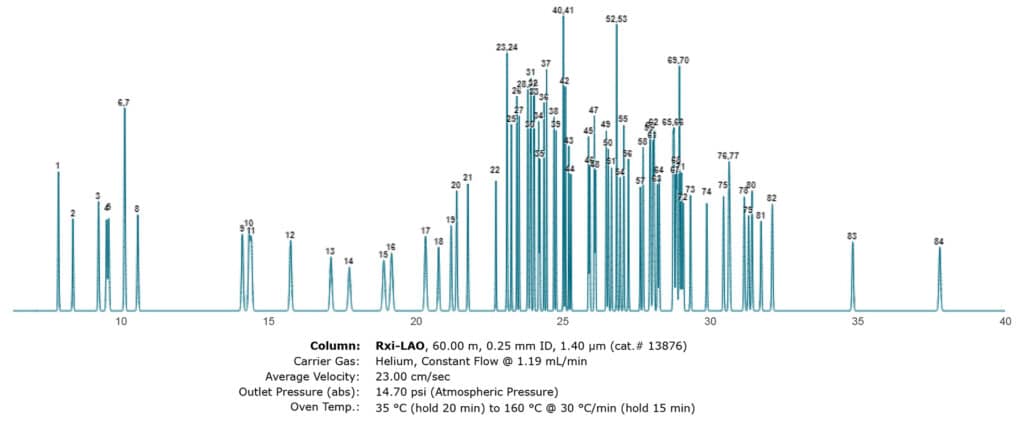

Specifically applicated for linear alpha olefins (LAO) impurity analysis, Restek’s new Rxi-LAO GC columns provide accurate analysis of LAO compounds including 1-butene, 1-hexene, and 1-octene. Combining a stationary phase with a unique selectivity and an optimal, one-column method, these new columns help labs improve their LAO analysis by increasing system uptime and sample throughput.
Rxi-LAO columns are defined by four key features:
- Unique selectivity enables high resolution of impurities from peaks of interest for excellent data quality.
- One-column method reduces instrument setup and analysis time, resulting in fast, accurate, and complete analysis.
- Application-specific column dimensions increase sample throughput.
- Pro EZGC chromatogram modeler libraries simplify analysis optimization.
A GC Column Applicated for Linear Alpha Olefins Analysis
Restek’s Rxi-LAO columns are the first GC columns specifically applicated for the impurity analysis of linear alpha olefins. Our unique selectivity achieves high resolution of impurities from peaks of interest, ensuring these new columns provide labs with the separation power needed for LAO impurity analysis (Figures 1 and 2).
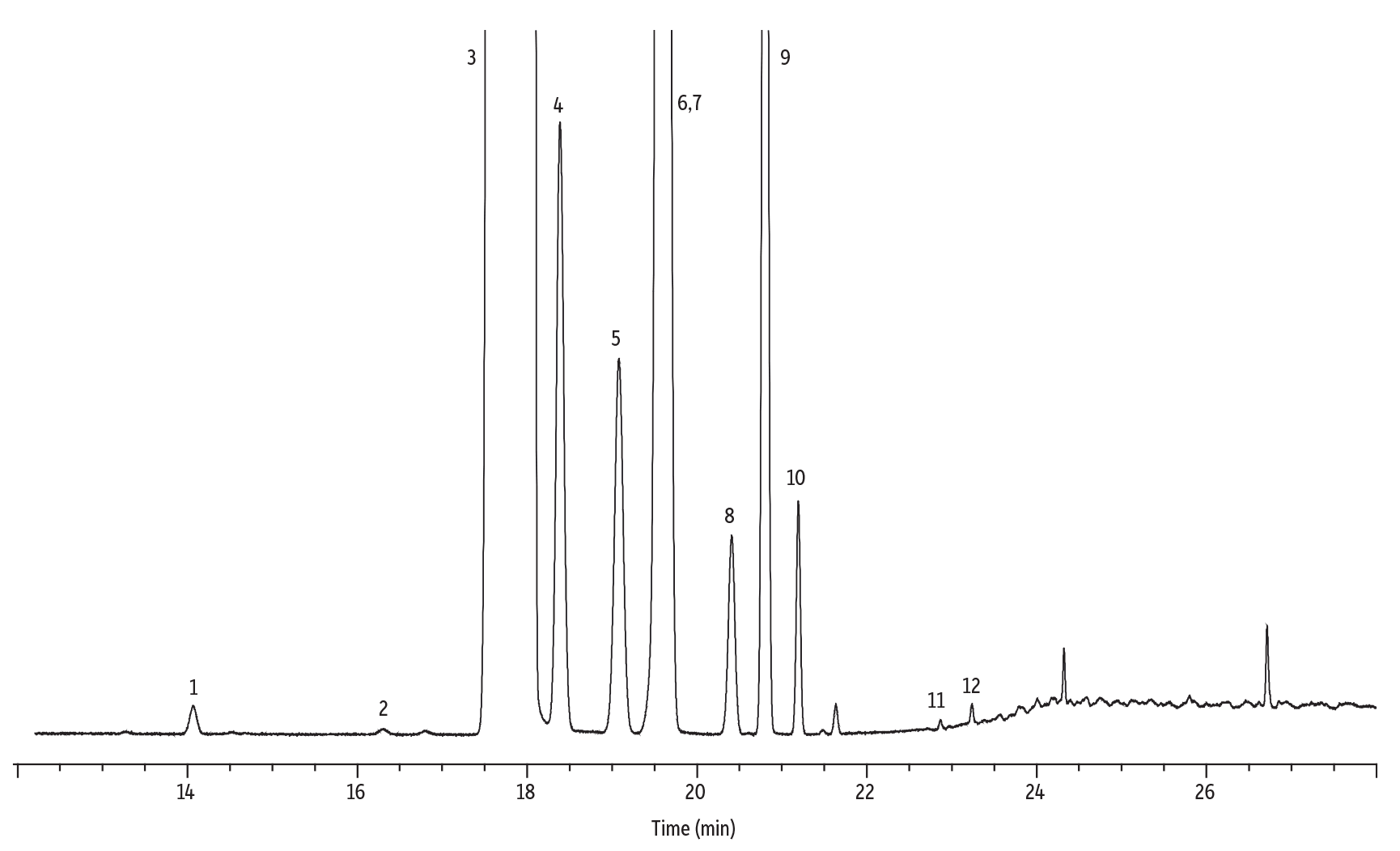
GC_PC1378
Peaks
| Peaks | tR (min) | |
|---|---|---|
| 1. | 3-Methyl-1-pentene | 14.06 |
| 2. | 3-Methylpentane | 16.31 |
| 3. | 1-Hexene | 18.04 |
| 4. | Hexane | 18.39 |
| 5. | 2-Ethyl-1-butene | 19.08 |
| 6. | cis-3-Hexene | 19.61 |
| Peaks | tR (min) | |
|---|---|---|
| 7. | trans-2-Hexene | 19.61 |
| 8. | cis-3-Methyl-2-pentene | 20.41 |
| 9. | cis-2-Hexene | 20.81 |
| 10. | trans-3-Methyl-2-pentene | 21.19 |
| 11. | Methyl-cyclopentene | 22.87 |
| 12. | Cyclohexene | 23.24 |
Conditions
| Column | Rxi-LAO, 60 m, 0.25 mm ID, 1.4 µm (cat.# 13876) |
|---|---|
| Standard/Sample | 1-Hexene |
| Conc.: | Neat solvent |
| Injection | |
| Inj. Vol.: | 1 µL split (split ratio 100:1) |
| Liner: | Topaz 4.0 mm ID low pressure drop Precision inlet liner w/wool (cat.# 23309) |
| Inj. Temp.: | 250 °C |
| Split Vent Flow Rate: | 125 mL/min |
| Oven | |
| Oven Temp.: | 35 °C (hold 20 min) to 160 °C at 30 °C/min (hold 20 min) |
| Carrier Gas | He, constant flow |
| Linear Velocity: | 23 cm/sec @ 35 °C |
| Detector | FID @ 300 °C |
|---|---|
| Make-up Gas Flow Rate: | 45 mL/min |
| Make-up Gas Type: | N2 |
| Hydrogen flow: | 40 mL/min |
| Air flow: | 450 mL/min |
| Data Rate: | 20 Hz |
| Instrument | Agilent 7890B GC |
| Sample Preparation | The sample was pipetted into a 2 mL vial (cat.# 21142) and capped with a short screw cap (cat.# 24498). |
| Notes | • Compounds were tentatively identified using a mass spectrometer and method translation. • A 208V instrument was used. • Benzene is not present in the sample, but if it were, it would elute at 23.73 minutes under these conditions. |
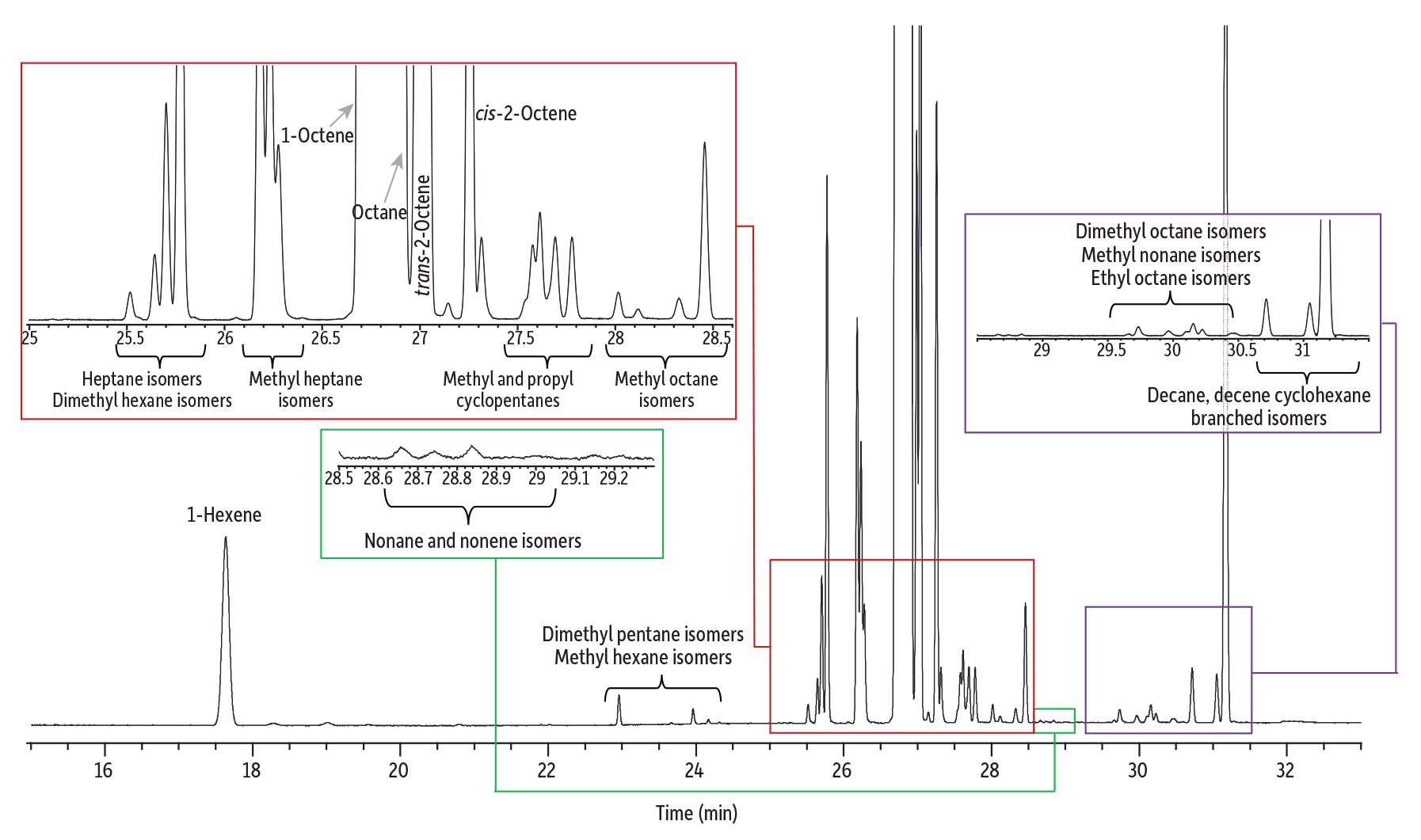
GC_PC1381
Conditions
| Column | Rxi-LAO, 60 m, 0.25 mm ID, 1.4 µm (cat.# 13876) |
|---|---|
| Standard/Sample | 1-Octene |
| Conc.: | Neat solvent |
| Injection | |
| Inj. Vol.: | 1 µL split (split ratio 100:1) |
| Liner: | Topaz 4.0 mm ID low pressure drop Precision liner w/wool (cat.# 23309) |
| Inj. Temp.: | 250 °C |
| Split Vent Flow Rate: | 125 mL/min |
| Oven | |
| Oven Temp.: | 35 °C (hold 20 min) to 160 °C at 30 °C/min (hold 20 min) |
| Carrier Gas | He, constant flow |
| Linear Velocity: | 23 cm/sec @ 35 °C |
| Detector | FID @ 300 °C |
|---|---|
| Make-up Gas Flow Rate: | 45 mL/min |
| Make-up Gas Type: | N2 |
| Hydrogen flow: | 40 mL/min |
| Air flow: | 450 mL/min |
| Data Rate: | 20 Hz |
| Instrument | Agilent 7890B GC |
| Sample Preparation | The sample was pipetted into a 2 mL vial (cat.# 21142) and capped with a short screw cap (cat.# 24498). |
| Notes | Peaks are tentatively identified. |
An LAO Workhorse: Increased Uptime and Increased Sample Throughput with a Single Column
As worldwide demand for polyethylene increases, so does the pressure on labs performing LAO impurity analysis. These labs need their GC columns to do more—accuracy isn’t enough: their columns need to be dependable and fast.
Rxi-LAO columns achieve high selectivity for liner alpha olefins impurities while requiring only a one-column method, resulting in substantial benefits compared to two-column or even current one-column methods. To help meet the needs of different labs, Rxi-LAO columns are available in two dimensions (Table I).
For labs using a two-column/two-GC method, we recommend our Rxi-LAO 60 m, 0.25 mm ID, 1.4 µm column (cat.# 13876). Compared to a two-column method, this single-column option halves the number of columns needed, resulting in reduced setup time, column costs, and analysis time while maintaining data quality (Figures 1 and 2).
For labs using a single-column method, we recommend our shorter, narrow-bore Rxi-LAO 40 m, 0.18 mm ID, 1.0 µm column (cat.# 40815). The smaller dimensions of this column enables fast analysis times while maintaining the separation power needed for LAO impurity analysis (Figures 3 and 4, Table II).
Table I: Switching to a one-column method using Rxi-LAO columns can offer labs substantial benefits over current methods.
| Current Method | Rxi-LAO Column Dimension for One-Column Method | Rxi-LAO Column Advantage | Benefits vs. Current Method |
| 2 GC/2 Column | 60 m, 0.25 mm ID, 1.4 µm (cat.# 13876) | One-column method reduces setup time. Optimal stationary phase selectivity reduces analysis time and yields good resolution of impurities. | Increased instrument uptime. Increased sample throughput. Accurate, complete results. |
| 1 GC/1 Column | 40 m, 0.18 mm ID, 1.0 µm (cat.# 40815) | Shorter, small ID column produces faster analysis times while maintaining impurity resolutions. | Increased sample throughput. Good data quality. |
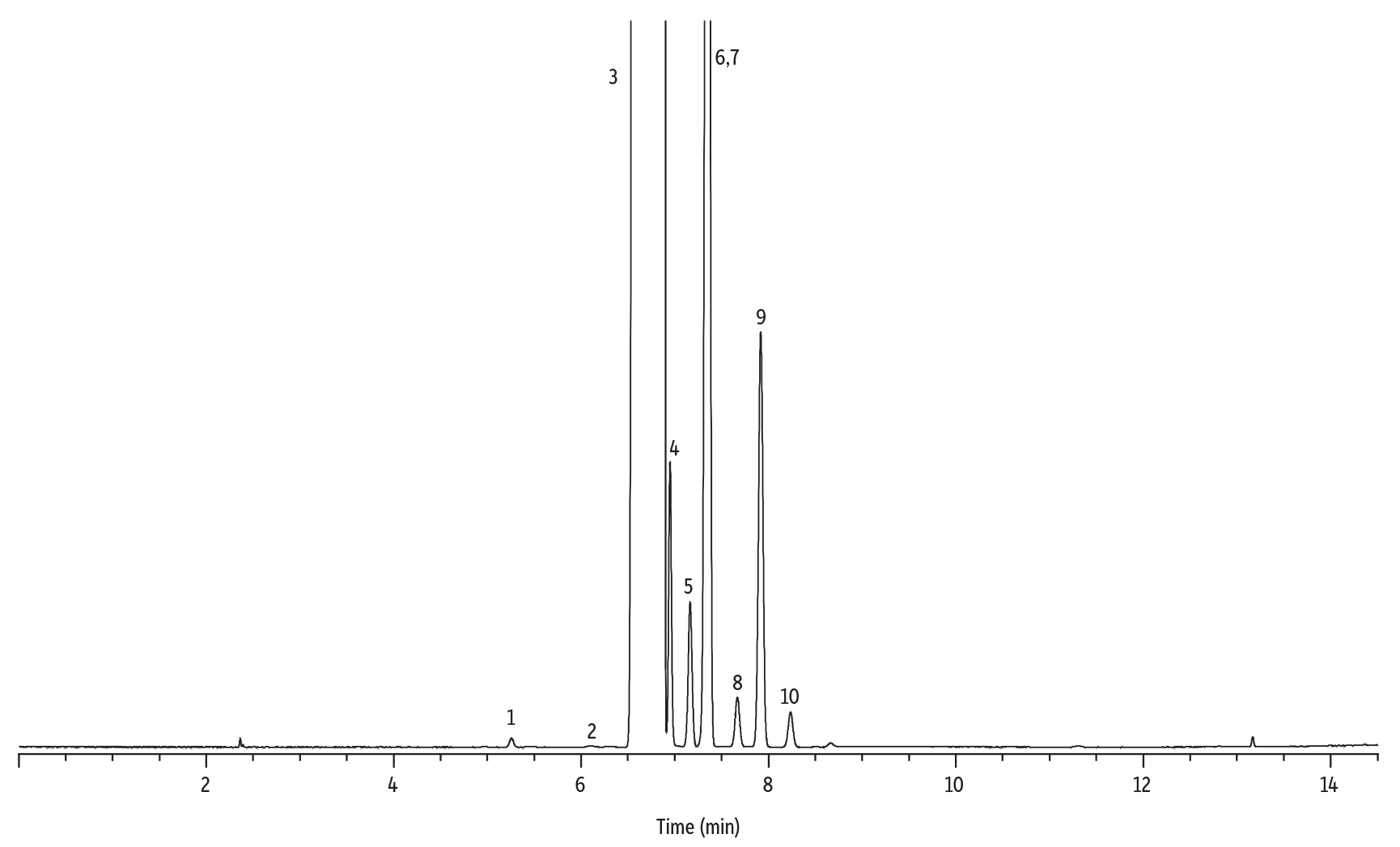
GC_PC1380
Peaks
| Peaks | tR (min) | |
|---|---|---|
| 1. | 3-Methyl-1-pentene | 5.25 |
| 2. | 3-Methylpentane | 6.10 |
| 3. | 1-Hexene | 6.87 |
| 4. | Hexane | 6.94 |
| 5. | 2-Ethyl-1-butene | 7.16 |
| 6. | cis-3-Hexene | 7.34 |
| 7. | trans-2-Hexene | 7.35 |
| 8. | cis-3-Methyl-2-pentene | 7.66 |
| 9. | cis-2-Hexene | 7.91 |
| 10. | trans-3-Methyl-2-pentene | 8.23 |
Conditions
| Column | Rxi-LAO, 40 m, 0.18 mm ID, 1.0 µm (cat.# 40815) |
|---|---|
| Standard/Sample | 1-Hexene |
| Conc.: | Neat solvent |
| Injection | |
| Inj. Vol.: | 1 µL split (split ratio 100:1) |
| Liner: | Topaz 4.0 mm ID low pressure drop Precision inlet liner w/wool (cat.# 23309) |
| Inj. Temp.: | 250 °C |
| Split Vent Flow Rate: | 178 mL/min |
| Oven | |
| Oven Temp.: | 35 °C (hold 11.85 min) to 160 °C at 50 °C/min (hold 12 min) |
| Carrier Gas | He, constant flow |
| Linear Velocity: | 39.19 cm/sec @ 35 °C |
| Detector | FID @ 300 °C |
|---|---|
| Make-up Gas Flow Rate: | 45 mL/min |
| Make-up Gas Type: | N2 |
| Hydrogen flow: | 40 mL/min |
| Air flow: | 400 mL/min |
| Data Rate: | 20 Hz |
| Instrument | Agilent 7890B GC |
| Sample Preparation | The sample was pipetted into a 2 mL vial (cat.# 21142) and capped with a short screw cap (cat.# 24498). |
| Notes | • Compounds were tentatively identified using a mass spectrometer and method translation. • A 208V instrument was used. • Benzene is not present in the sample, but if it were, it would elute at 12.36 minutes under these conditions. |
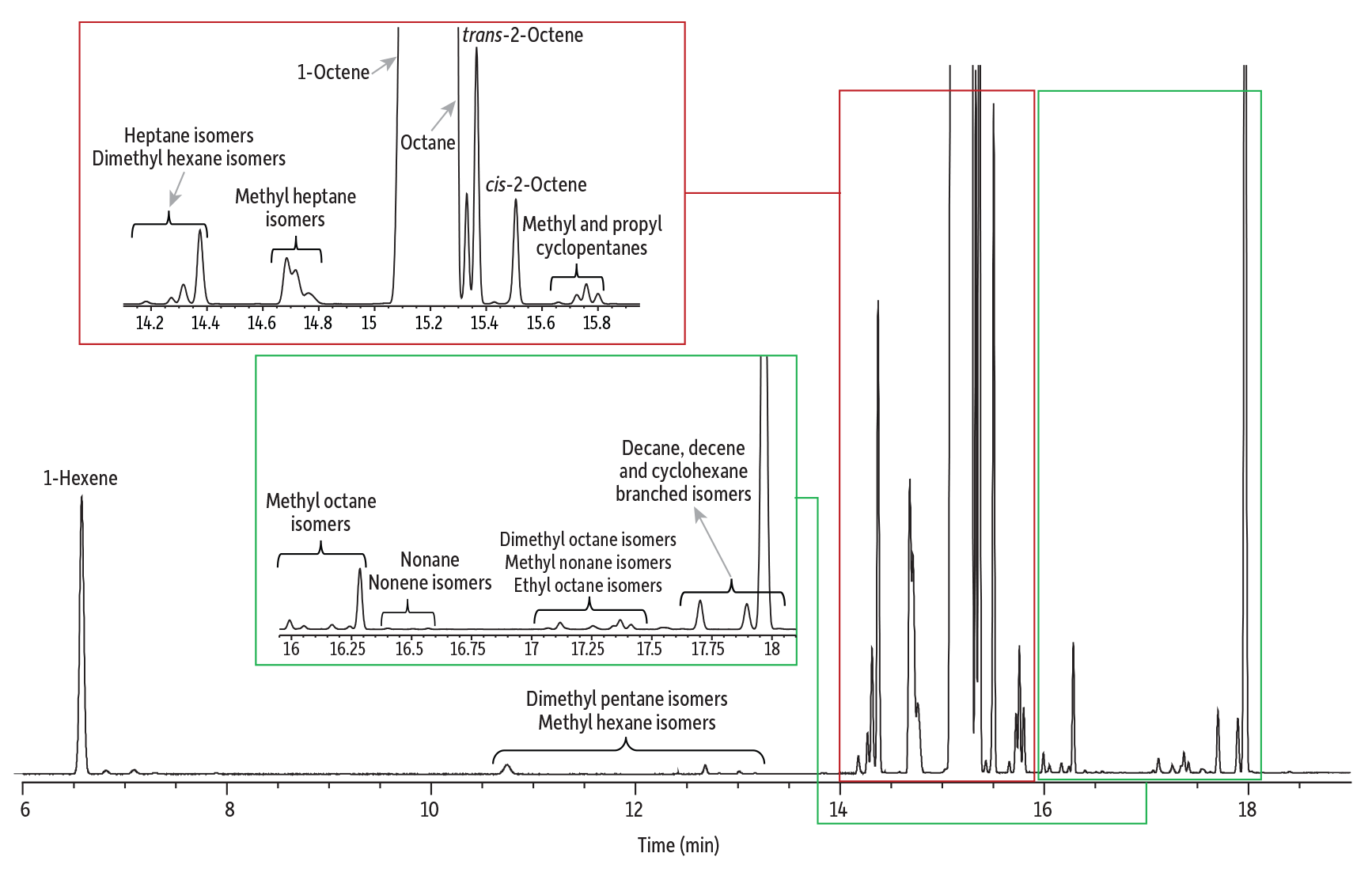
GC_PC1382
Conditions
| Column | Rxi-LAO, 40 m, 0.18 mm ID, 1.0 µm (cat.# 40815) |
|---|---|
| Standard/Sample | 1-Octene |
| Conc.: | Neat solvent |
| Injection | |
| Inj. Vol.: | 1 µL split (split ratio 100:1) |
| Liner: | Topaz 4.0 mm ID low pressure drop Precision inlet liner w/wool (cat.# 23309) |
| Inj. Temp.: | 250 °C |
| Split Vent Flow Rate: | 178 mL/min |
| Oven | |
| Oven Temp.: | 35 °C (hold 11.85 min) to 160 °C at 50 °C/min (hold 12 min) |
| Carrier Gas | He, constant flow |
| Linear Velocity: | 39.19 cm/sec @ 35 °C |
| Detector | FID @ 300 °C |
|---|---|
| Make-up Gas Flow Rate: | 45 mL/min |
| Make-up Gas Type: | N2 |
| Hydrogen flow: | 40 mL/min |
| Air flow: | 400 mL/min |
| Data Rate: | 20 Hz |
| Instrument | Agilent 7890B GC |
| Sample Preparation | The sample was pipetted into a 2 mL vial (cat.# 21142) and capped with a short screw cap (cat.# 24498). |
| Notes | • Peaks are tentatively identified. • A 208V instrument was used. |
Table II: The faster analysis times produced by the 40 m Rxi-LAO column (cat.# 40815) make it ideal for labs seeking a high throughput solution.
| Rxi-LAO Column Dimension | Run time (min) | |
| 1-Hexene Analysis | 1-Octene Analysis | |
| 60 m, 0.25 mm ID, 1.4 µm (cat.# 13876) | 24 | 32 |
| 40 m, 0.18 mm ID, 1.0 µm (cat.# 40815) | 9 | 18 |
Renowned Rxi Column Technology as Standard
As part of the Rxi GC column family, Rxi-LAO columns benefit from the industry-leading GC column technology that is standard across our entire Rxi column line.
High Reproducibility
Our Rxi-LAO columns feature unmatched manufacturing precision and stringent quality control to deliver high column-to-column reproducibility. This ensures your Rxi-LAO column performs to the same high standard with every analysis, even after changing the column (Figure 5).
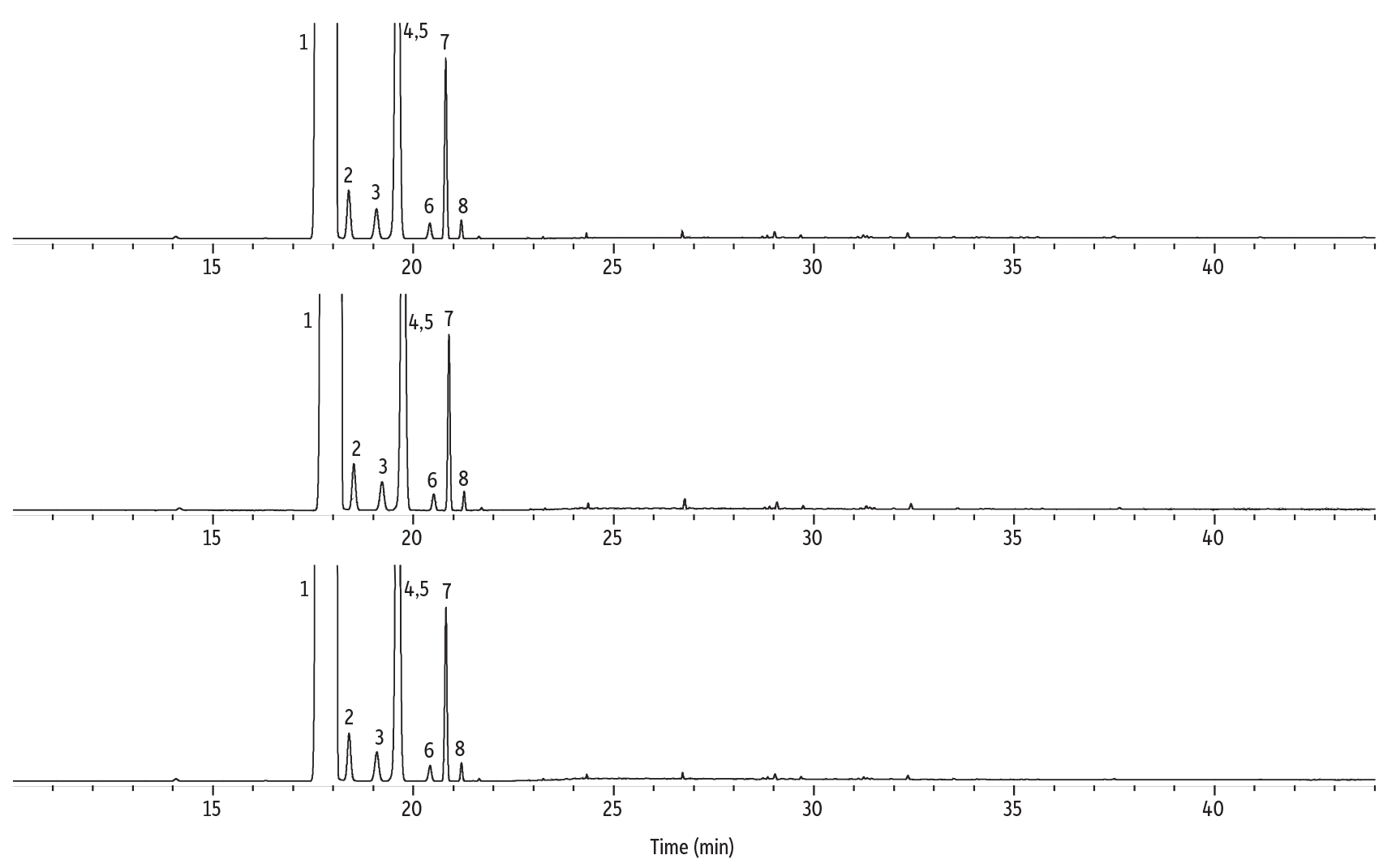
GC_PC1379
Peaks
| Peaks | tR (min) | |
|---|---|---|
| 1. | 1-Hexene | 18.04 |
| 2. | Hexane | 18.39 |
| 3. | 2-Ethyl-1-butene | 19.08 |
| 4. | cis-3-Hexene | 19.60 |
| 5. | trans-2-Hexene | 19.61 |
| 6. | cis-3-Methyl-2-pentene | 20.41 |
| 7. | cis-2-Hexene | 20.81 |
| 8. | trans-3-Methyl-2-pentene | 21.19 |
Conditions
| Column | Rxi-LAO, 60 m, 0.25 mm ID, 1.4 µm (cat.# 13876) |
|---|---|
| Standard/Sample | 1-Hexene |
| Conc.: | Neat solvent |
| Injection | |
| Inj. Vol.: | 1 µL split (split ratio 100:1) |
| Liner: | Topaz 4.0 mm ID low pressure drop Precision inlet liner w/wool (cat.# 23309) |
| Inj. Temp.: | 250 °C |
| Split Vent Flow Rate: | 125 mL/min |
| Oven | |
| Oven Temp.: | 35 °C (hold 20 min) to 160 °C at 30 °C/min (hold 20 min) |
| Carrier Gas | He, constant flow |
| Linear Velocity: | 23 cm/sec @ 35 °C |
| Detector | FID @ 300 °C |
|---|---|
| Make-up Gas Flow Rate: | 45 mL/min |
| Make-up Gas Type: | N2 |
| Hydrogen flow: | 40 mL/min |
| Air flow: | 450 mL/min |
| Data Rate: | 20 Hz |
| Instrument | Agilent 7890B GC |
| Sample Preparation | The sample was pipetted into a 2 mL vial (cat.# 21142) and capped with a short screw cap (cat.# 24498). |
Low Bleed
The high stability of our Rxi columns means they generate less bleed and reduce background to further improve signal-to-noise ratios, enhance sensitivity, and lower detection limits. Together, these two advanced technologies help ensure your LAO data is highly accurate and that you get the right results fast.
Learn more about the technology that goes into our Rxi GC columns at www.restek.com/rxi
Simplify Your Analysis Optimization with Pro EZGC Software
Rxi-LAO columns are fully supported by our Pro EZGC chromatogram modeler, allowing labs to simplify their analysis optimization. This free, easy-to-use software helps you perform GC method optimization and method development in minutes—without needing to use an instrument.
A powerful feature of Pro EZGC software is its ability to model the performance of different column dimensions. If your LAO impurity application currently uses a single-column method, and you would like to see how changing to the shorter, 40 m Rxi-LAO column can speed up your analysis, Pro EZGC software can be used to generate simulated results with exceptional accuracy.