











Featured Solutions






Unleash Your Performance with RMX GC Columns→
Get enhanced detection, less downtime, and more discovery with our new, next-generation GC columns.
Presentations
Poster Presentations
Simplifying PFAS Analyses in Fish Tissue with an Improved Dual-Bed Solid Phase Extraction Workflow
Monday, June 1, 10:30 a.m. – 2:30 p.m. | MP 091
Presenter: Ramkumar Dhandapani
Introduction
Quantifying PFAS in complex food matrices presents a significant analytical challenge due to matrix interferences and the need for highly sensitive detection limits, necessitating robust sample preparation to ensure accurate and reliable results. Despite its efficacy, solid phase extraction (SPE) faces challenges in numerous matrices where traditional ion-exchange sorbents fail to remove certain interferences, often requiring the additional implementation of dispersive carbon cleanup steps. Furthermore, particulates remaining from previous homogenization steps can obstruct SPE cartridges, extending loading times or necessitating the use of multiple cartridges to complete an analysis.
Methods
In this work, a tissue homogenizer was implemented and compared to a variable-speed mixing table for the extraction step in accordance with EPA Method 1633. Graphitized carbon black (GCB) and weak anion exchange (WAX) dual-bed SPE cartridges incorporating a novel filter aid were evaluated as a single-step extraction and cleanup format.
Preliminary Data
Recoveries for all 25 PFAS analytes in fortified samples ranged from 70% to 160%, except for ADONA and PFNA, and the relative standard deviation was less than 20% for most analytes. The tissue homogenizer minimized contamination risk by maintaining all steps within a single extraction tube and reduced the 16-hour shakeout to four minutes. The single SPE extraction and cleanup format provided a simplified and consistent approach for fish tissue while meeting accuracy and precision requirements for most analytes. Details of the LC–MS parameters employed will also be discussed
Novel Aspect
Comparative study, integrated WAX SPE with GCB and Filter Aid.
Advancements in GC for Picogram-Level Analysis for Semivolatiles and Pesticides by GC-MS/MS
Tuesday, June 2, 10:30 a.m. – 2:30 p.m. | TP 213
Presenter: Ramkumar Dhandapani
Introduction
Advances in MS sensitivity and the push for reduced solvent use are driving the development of more inert GC column technologies. Traditional fused‑silica tubing contains adsorptive silanol sites that hinder trace‑level analysis, and current deactivation methods often leave residual activity. This work introduces a new three‑dimensional deactivation architecture that improves surface passivation, enabling lower GC‑MS/MS quantification limits, enhanced column lifetime, and expanded applicability through innovative column formats.
Methods
The method involves the preparation and evaluation of gas chromatography (GC) columns manufactured using a newly developed surface‑deactivation process. This process creates a three‑dimensional network of bonding, crosslinking, and passivation within the fused‑silica capillary interior. The goal is to reduce the number of active sites that contribute to analyte adsorption, particularly for semivolatile compounds analyzed at low concentrations. To assess its effectiveness, columns produced with this deactivation are conditioned under typical GC operating temperatures and subsequently evaluated using a representative mixture of semivolatile and pesticide analytes. Performance characteristics; including peak shape, analyte recovery, calibration range, and chromatographic stability, are measured under standard GC‑MS/MS operating conditions.
Preliminary Data
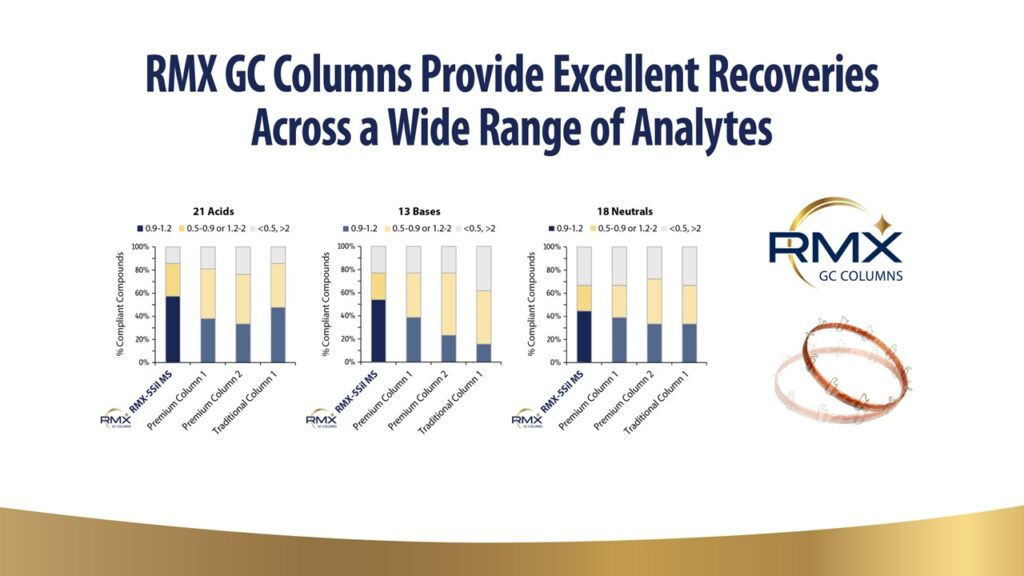
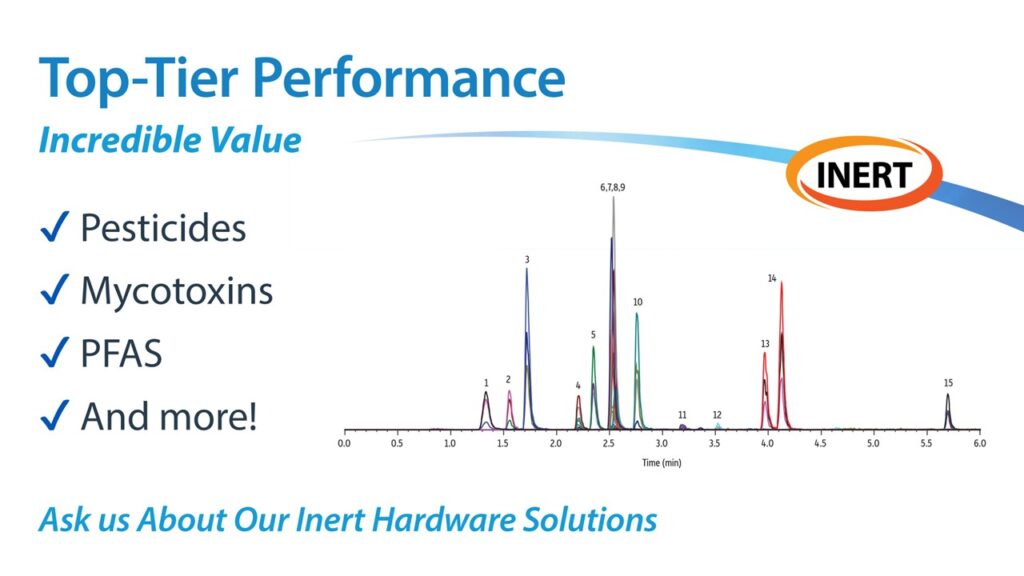
Preliminary evaluations of the newly developed three‑dimensional deactivation demonstrated robust chromatographic performance for a wide range of chemically diverse and traditionally challenging semivolatile organic compounds. Representative analytes included phenols (e.g., phenol, 2,4,6‑trichlorophenol, pentachlorophenol); nitroaromatics (e.g., nitrobenzene, 2,4‑dinitrotoluene); phthalates (e.g., di‑n‑butyl phthalate, bis(2‑ethylhexyl) phthalate); chlorinated benzenes (e.g., 1,4‑dichlorobenzene, hexachlorobenzene); and polycyclic aromatic hydrocarbons (PAHs), such as naphthalene, acenaphthene, chrysene, and benzo[a]pyrene. These analytes reflect the broad chemical diversity typically evaluated in EPA Method 8270E workflows for trace‑level GC‑MS/MS analysis. Across this analyte set, picogram‑level detection was reproducibly achieved. Chromatographic assessment included a comprehensive evaluation of peak shape, recovery, precision over multiple concentration levels, calibration linearity, and quantitative stability—criteria aligned with standard semivolatile method performance expectations. The enhanced passivation provided by the 3D deactivation significantly reduced interaction with residual active sites, resulting in symmetric peak profiles and improved low‑level quantitative performance. Recovery studies showed consistent analyte response across acidic, basic, and neutral compounds, indicating that the deactivation maintained inertness across diverse chemical classes. Precision assessments demonstrated low relative standard deviations across concentration ranges, supporting suitability for trace‑level quantification. Additionally, method parameter robustness (including inlet conditions, oven temperature programs, and MS/MS acquisition parameters) confirmed that the deactivation facilitated stable analytical performance under typical operating conditions, consistent with trends observed in high‑inertness GC-MS/MS semivolatile studies. Collectively, these results demonstrate that the new deactivation chemistry enables high‑sensitivity, low‑level quantification of complex semivolatile analytes while supporting the analytical rigor required for comprehensive GC‑MS/MS workflows.
Novel Aspect
A novel three‑dimensional deactivation network enhances inertness, lowers quantification limits, improving GC‑MS/MS to picogram level.
Improved Baseline Stability and Sensitivity in GC–MS Using a Novel Column with an Uncoated Interface Section
Tuesday, June 2, 10:30 a.m. – 2:30 p.m. | TP 214
Presenter: Javier Arrebola (University of Almeria)
Introduction
Persistent challenges in GC–MS workflows—particularly baseline instability, elevated background noise, and sensitivity loss—are often linked to stationary phase degradation and thermal stress near the interface region. These issues become more pronounced at higher transfer‑line temperatures and can negatively impact detection of high‑boiling‑point or thermally sensitive analytes. To address these limitations, a new GC–MS column design incorporating an uncoated interface section was developed to reduce thermally driven degradation processes and stabilize baseline behavior.
Methods
The column incorporates a thermally robust, uncoated segment positioned at the GC–MS interface to limit stationary phase exposure to high temperatures. Performance was evaluated using a diverse set of pesticide analytes covering a range of volatilities and thermal characteristics. Measurements included baseline stabilization time, background signal level, signal‑to‑noise ratios, and detection behavior in both full‑scan and selected‑ion monitoring (SIM) modes. Comparative assessments were performed under identical instrumental conditions to isolate the effect of the interface modification.
Preliminary Data
Early results show that the modified column configuration provides substantially faster baseline stabilization and a measurable reduction in background noise. Improvements in signal‑to‑noise ratio were consistently observed for both scanning modes, with the greatest gains occurring in high‑boiling‑point and late‑eluting analytes—compounds typically most affected by thermal stress and column bleed. The reduced bleed and improved chromatographic stability suggest lower analyte loss and enhanced reliability in detecting thermally labile species.
Novel Aspect
Novel GC stationary phase format designed for GC-MS interface offering improved sensitivity in MS/MS setup
Advancements in GC Column Deactivation for Robust Multiclass Semivolatile Analysis
Tuesday, June 2, 10:30 a.m. – 2:30 p.m. | TP 215
Presenter: Jennifer Lindner
Introduction
Gas chromatography of semivolatiles continues to be limited by residual surface silanols on fused‑silica capillaries, which promote adsorption, peak distortion, and reduced sensitivity—particularly for acidic and basic analytes at trace levels. Deactivation plays a central role in eliminating these active sites and ensuring stable adhesion of the stationary phase. However, incomplete or unstable deactivation can accelerate thermal phase degradation and impair long‑term chromatographic performance. The attached study examines an advanced deactivation system designed to balance the performance of acidic, basic, and neutral compounds; improve column robustness under thermal stress; and support consolidated GC–MS/MS workflows for complex analyte lists.
Methods
Multiple GC columns manufactured with the new deactivation were evaluated through controlled quality control (QC) tests and targeted stress studies. Lot‑to‑lot consistency was assessed using QC probe compounds sensitive to silanol activity. Columns were subjected to 15 thermal‑stress cycles at 330 °C with extended high‑temperature holds to accelerate phase deterioration. Peak shape, symmetry, and performance drift were monitored before and after stress cycling. In addition, 63 acidic, basic, and neutral compounds were calibrated according to EPA 8270E criteria (0.5–5000 ppb) to evaluate linearity, response‑factor stability, and mid‑level peak symmetry. A broader mixture of >150 semivolatiles was analyzed at 10 pg on‑column to assess suitability for large analyte lists and simultaneous multiclass quantification.
Preliminary Data
The enhanced deactivation demonstrated consistent peak shape for acidic and basic analytes, maintaining symmetry even after extensive thermal stress cycling. QC chromatograms from multiple manufacturing batches showed high reproducibility, indicating fewer residual active sites and improved coating adhesion. Calibration of 63 representative compounds showed strong linearity without weighting, and mid‑level peak‑shape criteria were met across a larger proportion of analytes than typically observed in traditional 5‑type columns. The analysis of >150 semivolatiles at 10 pg produced clear, well‑defined peaks across acids, bases, and neutrals, demonstrating suitability for trace‑level quantification and method consolidation. These outcomes collectively indicate reduced activity, lower baseline variability, and improved robustness for demanding GC–MS/MS applications.
Novel Aspect
Three‑dimensional deactivation improves inertness, enhances thermal resilience, balances acidic–basic peak shapes, enables trace‑level quantification, and supports large, multiclass semivolatile workflows.
Low-Level LC-MS/MS Analysis of Steroid Hormones in Human Serum and Plasma
Thursday, June 4, 10:30 a.m. – 2:30 p.m. | TP 143
Presenter: Jared Burkhart | Author: Haley Berkland
Introduction
Analysis of steroid hormones provides clinical insight into many biological processes within the body. While LC-MS/MS is the gold standard for this type of testing, there are several challenges laboratories face when developing a comprehensive method for steroid hormone analysis. In this work, a complete workflow was developed for the low-level analysis of 16 steroid hormones in serum and plasma by LC-MS/MS. The developed workflow avoids the use of ammonium fluoride, which can be hazardous to both the analytical instrumentation and laboratory personnel.
Methods
A total of 16 steroid hormones were extracted from serum and plasma samples using supported liquid extraction (SLE). Following extraction, samples were dried down, derivatized using 2-fluoro-1-methylpyridinium p-toluenesulfonate (FMP-TS), and incubated for 15 minutes at 50 °C. Samples were dried down under nitrogen and reconstituted in 100 µL 60:40 water:methanol, both with 0.1% formic acid (v/v). Samples were then injected on a Shimadzu LCMS-8045 system for analysis. Chromatographic separation was performed using a Force Inert C18 100 x 2.1 mm, 1.8 µm column. The mobile phases used were water and methanol, both with 0.1% formic acid and 2 mM ammonium formate. The column temperature was 60 °C and the flow rate was 0.4 mL/min. Gradient elution was employed, with a total method run time of eight minutes.
Preliminary Data
Derivatization with FMP-TS was found to be highly effective in improving the sensitivity of steroid hormones. The derivatization agent reacts with primary and secondary hydroxyl groups, applying a permanent positive charge to the analytes and enhancing ionization. When analyzing the underivatized analytes by the described method, the compound estrone was nearly undetectable at a concentration of 125 ng/dL. When the FMP-TS derivative was analyzed, the signal increased by more than 4000% at the same concentration. The developed method demonstrated acceptable linearity, precision, and accuracy in serum and plasma. Detection limits of ≤ 10 ng/dL were achieved for most analytes. Method performance was further verified by analysis of external quality control samples.
Novel Aspect
The developed method achieves low-level detection of steroids hormones by LC-MS/MS while avoiding the use of ammonium fluoride to enhance ionization.