

亮点
- 两种快速、简便的直接进样(Direct Injection)方法,可为饮用水中的双酚类化合物提供基线分离和准确的定量结果。
- 针对 BPA、BPS 和 BPB 的目标物方法符合欧盟指令的灵敏度要求,定量下限(LLOQ, Lower Limit of Quantitation)为 2.5 µg/L。
- 涵盖 15 种双酚类化合物的综合方法,可支持希望预先应对法规变化、扩展目标物清单的实验室。
摘要
双酚类化合物是常用于生产聚碳酸酯塑料和环氧树脂的合成化学品,因而成为分布广泛的环境污染物。其结构与雌激素相似,使其可作为内分泌干扰物(Endocrine Disruptor),引发了对其存在于饮用水中的担忧。虽然“无 BPA”产品常使用 BPS 和 BPB 等替代物,但这些替代品同样可能带来健康风险。本研究提出了一种快速、可靠的方法,用于检测饮用水中的 BPA、BPS 和 BPB,并符合欧盟法规要求。另一种方法将检测范围扩展至 15 种双酚类化合物,为开展全面饮用水污染检测的实验室提供了切实可行的方案。
前言
双酚类化合物是一类人工合成化学品,可作为污染物存在于食品和环境中。这些合成酚类主要用于生产聚碳酸酯塑料和环氧树脂。由于这些化合物在全球范围内被普遍生产和使用,双酚类污染物很可能存在于环境和饮用水中。2011 年,美国国立卫生研究院(NIH)的一项研究发表结果显示,研究中 427 人里有 91% 的尿样检出 Bisphenol A [1]。双酚类化合物具有共同的基本结构,即由一个桥连基团连接两个酚基。这种与雌激素相似的结构使它们能够模拟并干扰天然激素功能,因而被归类为内分泌干扰物 [2]。Bisphenol A、B 和 S 是已被证实与人体健康影响相关的部分化合物,其中 Bisphenol A 尤为突出,监管机构正在推动限制或禁止在食品接触材料和儿童玩具中使用双酚类化合物。
尽管世界部分地区已有相关法规,双酚类化合物及其衍生物仍被大量使用且应用于种类繁多的商品中,这增加了它们经由环境途径进入供水系统的可能性。Bisphenol S 已被用作“无 BPA”产品中 Bisphenol A 的替代品,但它同样存在健康隐患,并已在加利福尼亚州 Proposition 65 中被认定为生殖毒性物质 [3]。Bisphenol B 在消费品中被用作 Bisphenol A 和 Bisphenol S 的替代品,但其内分泌干扰能力同样令人担忧 [4]。欧盟(EU)《饮用水指令》已将 Bisphenol A 列为一项参数,到 2026 年 1 月,供水企业必须确保饮用水中 Bisphenol A 的含量不超过 2.5 µg/L 的参数限值 [5]。
本研究建立了两种用于饮用水中双酚类化合物的直接进样液相色谱-串联质谱(LC-MS/MS)方法。由于 Bisphenol A、B 和 S 是最常分析的双酚类化合物,本文针对这些化合物开发了一种快速、可靠的方法。该方法满足欧盟《饮用水指令》的要求,并使用加标(Spiking)水样评价了准确度(Accuracy)和精密度(Precision)。此外,还开发了另一种涵盖共 15 种双酚类化合物的综合方法,为应对预期的法规变化提供了前瞻性方案。本文所述方法为希望开展或扩展污染检测的实验室提供了快速、简便的饮用水双酚类分析解决方案。
实验部分
双酚 A、B、S 的 LC-MS/MS 方法
色谱条件见表 I,离子对和内标见表 II。
表 I: Bisphenol A、B 和 S 的分析条件
| 色谱柱 | Raptor Biphenyl 50 x 3.0 mm, 2.7 µm (货号: 9309A5E) | |
| 保护柱 | Raptor Biphenyl EXP guard column cartridge 5 x 3.0 mm, 2.7 µm (货号: 9309A0253) | |
| 柱温 | 30 °C | |
| 进样量 | 10 µL | |
| 流动相 A | Water | |
| 流动相 B | 甲醇 | |
| 流速 | 0.8 mL/min | |
| 检测 | ESI (-) MS/MS | |
| 梯度 | 时间 (min) | %B |
| 0.00 | 40 | |
| 0.50 | 40 | |
| 3.50 | 85 | |
| 3.51 | 40 | |
| 5.00 | 40 | |
| 阀门切换至废液端 | 0.00 | – |
| 阀门切换至质谱端 | 0.80 | – |
| 阀门切换至废液端 | 3.51 | – |
表 II: 水样中双酚A、B 和 S 的质谱 离子对信息
| 目标物 | 母离子 | 子离子 1 | 子离子 2 | 内标 |
|---|---|---|---|---|
| Bisphenol S | 249.00 | 108.15 | 92.10 | 1 |
| Bisphenol A | 227.00 | 212.05 | 133.25 | 2 |
| Bisphenol B | 241.00 | 212.05 | 211.10 | 2 |
| Bisphenol A-d16 | 241.00 | 223.25 | – | 2 |
| Bisphenol S-d8 | 257.00 | 112.20 | – | 1 |
双酚类化合物的综合 LC-MS/MS 方法
色谱条件见表 III,离子对和内标见表 IV。
表 III: 15 种双酚类化合物的分析条件
| 色谱柱 | Raptor Biphenyl 50 x 3.0 mm, 2.7 µm (货号: 9309A5E) | |
| 保护柱 | Raptor Biphenyl EXP guard column cartridge 5 x 3.0 mm, 2.7 µm (货号: 9309A0253) | |
| 柱温 | 30 °C | |
| 进样量 | 10 µL | |
| 流动相 A | 水 | |
| 流动相 B | 甲醇 | |
| 流速 | 0.8 mL/min | |
| 检测器 | ESI (-) MS/MS | |
| 梯度 | 时间 (min) | %B |
| 0.00 | 40 | |
| 1.00 | 40 | |
| 6.50 | 85 | |
| 7.00 | 85 | |
| 7.01 | 40 | |
| 8.50 | 40 | |
| 阀门切换至废液端 | 0.00 | – |
| 阀门切换至质谱端 | 1.00 | – |
| 阀门切换至废液端 | 7.00 | – |
表 IV: 水样中 15 种双酚类化合物的质谱离子对信息
| 目标物 | 母离子 | 子离子 1 | 子离子 2 | 内标 |
|---|---|---|---|---|
| Bisphenol S-d8 | 257.00 | 112.20 | – | 1 |
| Bisphenol S | 249.00 | 108.15 | 92.10 | 1 |
| Bisphenol F | 199.00 | 93.10 | 104.85 | 2 |
| Bisphenol E | 213.00 | 197.10 | 119.05 | 2 |
| Bisphenol A-d16 | 241.00 | 223.25 | – | 2 |
| Bisphenol A | 227.00 | 212.05 | 133.25 | 2 |
| Bisphenol AF | 335.00 | 265.05 | 177.20 | 3 |
| Bisphenol B | 241.00 | 212.05 | 211.10 | 2 |
| Bisphenol C | 255.00 | 240.15 | 147.20 | 2 |
| Bisphenol AP | 289.00 | 274.15 | 273.15 | 2 |
| Bisphenol Z | 267.00 | 173.15 | 223.10 | 2 |
| Bisphenol G | 311.00 | 296.30 | 295.00 | 3 |
| Bisphenol FL | 349.00 | 256.15 | 215.20 | 2 |
| Bisphenol BP | 351.00 | 274.15 | 273.15 | 3 |
| Bisphenol M | 345.00 | 251.20 | 330.20 | 3 |
| Bisphenol P-13C4 | 349.00 | 333.20 | – | 3 |
| Bisphenol P | 345.00 | 330.15 | 315.15 | 3 |
| Bisphenol PH | 379.00 | 364.10 | 209.15 | 3 |
标准品与样品制备
双酚类 LC-MS/MS 方法的校准标准品按如下方式配制,浓度范围为 2.5-300 µg/L。在棕色样品瓶(货号:21142)中,将 30 µL 浓度为 1 mg/L 的同位素标记内标(Isotope-labeled Internal Standard, IS)与 50 µL 工作标准品和 920 µL MS 级水混合。在当地采集了五种不同来源的饮用水。在准确度和精密度实验中,向 1 mL 水样中分别加标至 2.5(LLOQ)、7.5(低浓度质控 LQC)和 75(中浓度质控 MQC)µg/L。所有样品加盖、涡旋混匀后,取 10 µL 注入 LC-MS/MS 进行分析。
结果与讨论
色谱性能
在本文建立的色谱条件下,Raptor Biphenyl 色谱柱在针对 BPA、BPB 和 BPS 的目标物方法以及涵盖 15 种双酚类化合物的综合方法中均实现了完全分离。完全的色谱分离对 MS 检测很有帮助,因为它可减轻共流出目标物引起的离子抑制(Ion Suppression)。这也使得这些方法可适用于价格更低、非特异性的荧光检测器分析——此类检测器需要基线分离才能准确积分各目标物。两种双酚类 LC-MS/MS 分析方法均采用直接进样且运行时间短,适用于高通量检测环境。三组分双酚类方法的总循环时间为 5 分钟,综合 15 组分方法的循环时间为 8.5 分钟。为减少基质效应(Matrix Effect)以及进入 MS 的基质量,在化合物洗脱前后使用切换阀将流出液导入废液。采用该步骤是因为它可使仪器在需要维护前分析更多样品,从而减少停机时间。
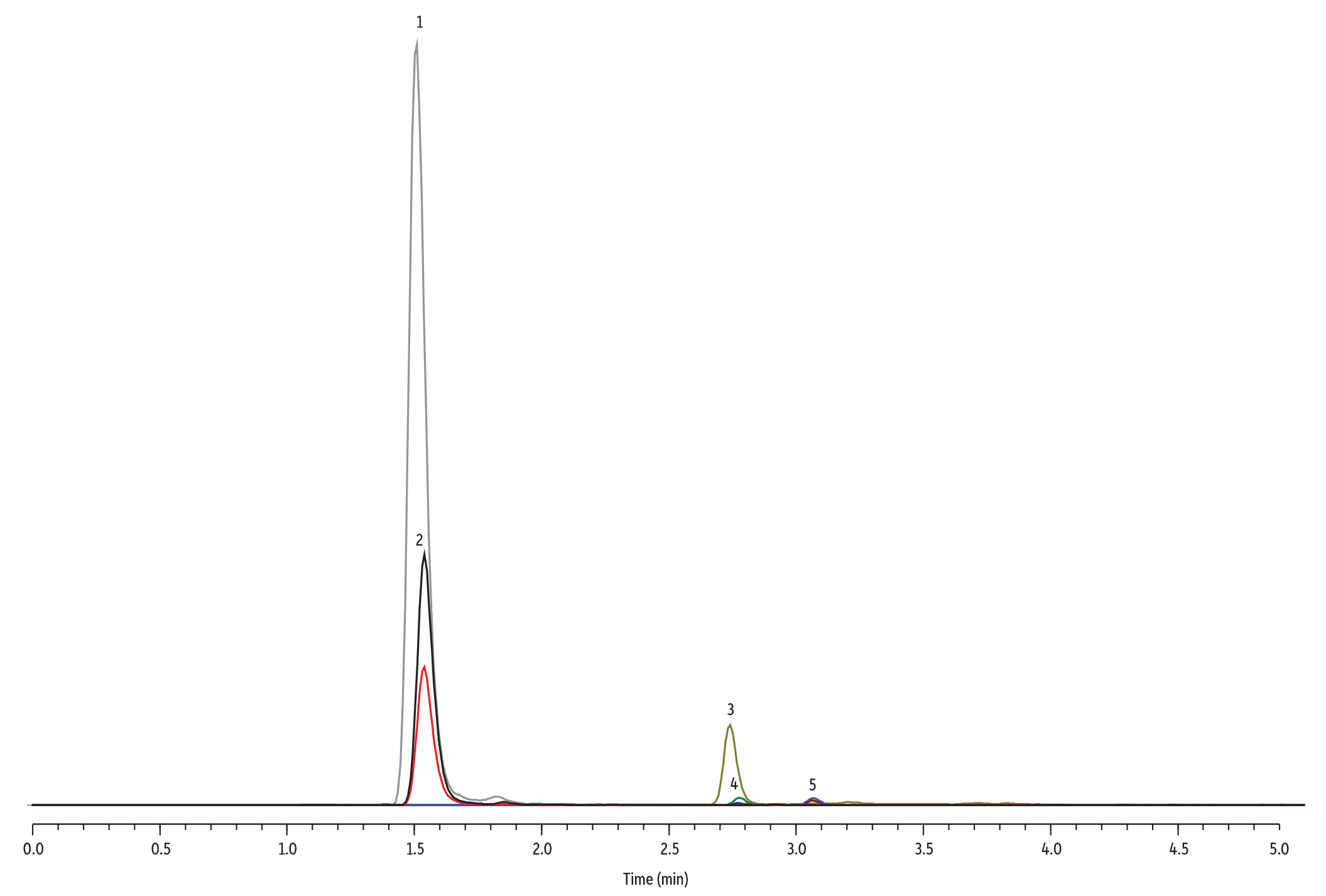
LC_EV0603
Peaks
| Peaks | tR (min) | Conc. (ng/mL) | Precursor Ion | Product Ion 1 | Product Ion 2 | |
|---|---|---|---|---|---|---|
| 1. | Bisphenol S (BPS) | 1.57 | 2.5 | 249.0 | 108.2 | 92.1 |
| 2. | Bisphenol S-d8 | 1.57 | 30 | 257.0 | 112.2 | – |
| 3. | Bisphenol A (BPA) | 2.74 | 2.5 | 227.0 | 212.1 | 133.3 |
| 4. | Bisphenol A-d16 | 2.77 | 30 | 241.0 | 223.3 | – |
| 5. | Bisphenol B (BPB) | 3.06 | 2.5 | 241.0 | 212.1 | 211.1 |
Conditions
| Column | Raptor Biphenyl (cat.# 9309A5E) | ||||||||||||||||||||||||
|---|---|---|---|---|---|---|---|---|---|---|---|---|---|---|---|---|---|---|---|---|---|---|---|---|---|
| Dimensions: | 50 mm x 3.0 mm ID | ||||||||||||||||||||||||
| Particle Size: | 2.7 µm | ||||||||||||||||||||||||
| Pore Size: | 90 Å | ||||||||||||||||||||||||
| Guard Column: | Raptor Biphenyl EXP guard column cartridge 5 mm, 3.0 mm ID, 2.7 µm (cat.# 9309A0253) | ||||||||||||||||||||||||
| Temp.: | 30 °C | ||||||||||||||||||||||||
| Standard/Sample | |||||||||||||||||||||||||
| Diluent: | Water | ||||||||||||||||||||||||
| Conc.: | 2.5 ng/mL | ||||||||||||||||||||||||
| Inj. Vol.: | 10 µL | ||||||||||||||||||||||||
| Mobile Phase | |||||||||||||||||||||||||
| A: | Water | ||||||||||||||||||||||||
| B: | Methanol | ||||||||||||||||||||||||
| |||||||||||||||||||||||||
| Max Pressure: | 330 bar |
| Detector | Shimadzu 8060 MS/MS |
|---|---|
| Ion Source: | Electrospray |
| Ion Mode: | ESI- |
| Mode: | MRM |
| Instrument | Shimadzu Nexera X2 |
| Sample Preparation | Water samples were aliquoted into an amber short-cap vial (cat.# 21142) and fortified with analytes at 2.5 ng/mL. The samples were then capped with a 9 mm short cap (cat.# 24497) and vortexed ~30 seconds before being injection onto the LC-MS/MS for analysis. |
| Notes | The flow was directed to waste for the first 0.8 minutes of analysis and after 3.50 minutes to maintain cleanliness of the source. |
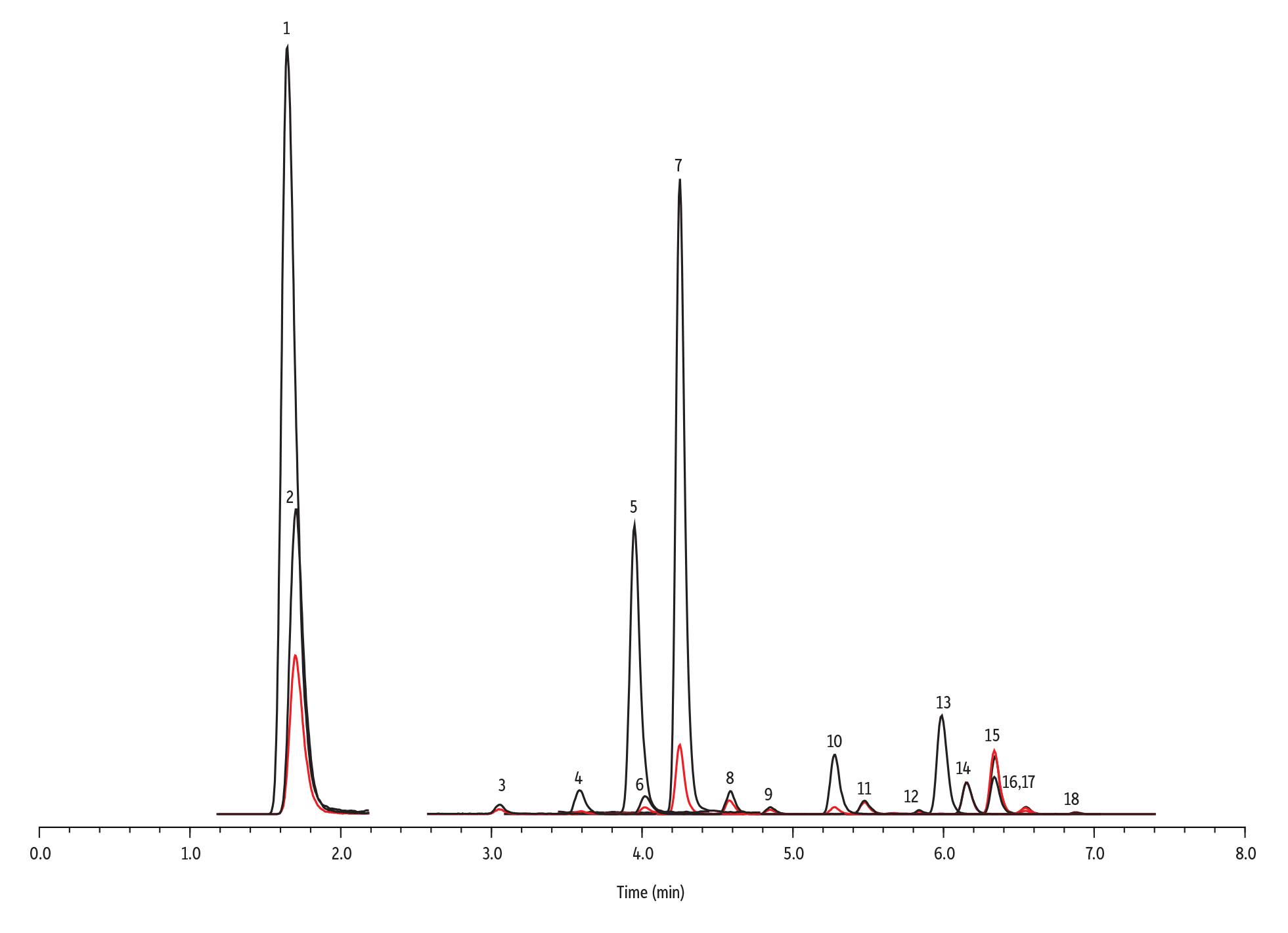
LC_EV0604
Peaks
| Peaks | tR (min) | Conc. (ng/mL) | Precursor Ion | Product Ion 1 | Product Ion 2 | Internal Standard | |
|---|---|---|---|---|---|---|---|
| 1. | Bisphenol S-d8 | 1.65 | 30 | 257.0 | 112.2 | – | 1 |
| 2. | Bisphenol S (BPS) | 1.70 | 2.5 | 249.0 | 108.1 | 92.1 | 1 |
| 3. | Bisphenol F (BPF) | 3.06 | 2.5 | 199.0 | 93.1 | 104.9 | 2 |
| 4. | Bisphenol E (BPE) | 3.59 | 2.5 | 213.0 | 197.1 | 119.1 | 2 |
| 5. | Bisphenol A-d16 | 3.95 | 30 | 241.0 | 223.3 | – | 2 |
| 6. | Bisphenol A (BPA) | 4.02 | 2.5 | 227.0 | 212.1 | 133.3 | 2 |
| 7. | Bisphenol AF (BPAF) | 4.25 | 2.5 | 335.0 | 265.1 | 177.2 | 3 |
| 8. | Bisphenol B (BPB) | 4.59 | 2.5 | 241.0 | 212.1 | 211.1 | 2 |
| 9. | Bisphenol C (BPC) | 4.85 | 2.5 | 255.0 | 240.2 | 147.2 | 2 |
| 10. | Bisphenol AP (BPAP) | 5.28 | 2.5 | 289.0 | 274.2 | 273.2 | 2 |
| 11. | Bisphenol Z (BPZ) | 5.48 | 2.5 | 267.0 | 173.2 | 223.1 | 2 |
| 12. | Bisphenol G (BPG) | 5.84 | 2.5 | 311.0 | 296.3 | 295.0 | 3 |
| 13. | Bisphenol FL (BPFL) | 5.99 | 2.5 | 349.0 | 256.2 | 215.2 | 2 |
| 14. | Bisphenol BP (BPBP) | 6.15 | 2.5 | 351.0 | 274.2 | 273.2 | 3 |
| 15. | Bisphenol M (BPM) | 6.34 | 2.5 | 345.0 | 251.2 | 330.2 | 3 |
| 16. | Bisphenol P-13C4 | 6.50 | 30 | 349.0 | 333.2 | – | 3 |
| 17. | Bisphenol P (BPP) | 6.55 | 2.5 | 345.0 | 330.2 | 315.2 | 3 |
| 18. | Bisphenol PH (BPPH) | 6.87 | 2.5 | 379.0 | 364.1 | 209.2 | 3 |
Conditions
| Column | Raptor Biphenyl (cat.# 9309A5E) | ||||||||||||||||||||||||||||
|---|---|---|---|---|---|---|---|---|---|---|---|---|---|---|---|---|---|---|---|---|---|---|---|---|---|---|---|---|---|
| Dimensions: | 50 mm x 3.0 mm ID | ||||||||||||||||||||||||||||
| Particle Size: | 2.7 µm | ||||||||||||||||||||||||||||
| Pore Size: | 90 Å | ||||||||||||||||||||||||||||
| Guard Column: | Raptor Biphenyl EXP guard column cartridge 5 mm, 3.0 mm ID, 2.7 µm (cat.# 9309A0253) | ||||||||||||||||||||||||||||
| Temp.: | 30 °C | ||||||||||||||||||||||||||||
| Standard/Sample | |||||||||||||||||||||||||||||
| Diluent: | Water | ||||||||||||||||||||||||||||
| Conc.: | 2.5 ng/mL | ||||||||||||||||||||||||||||
| Inj. Vol.: | 10 µL | ||||||||||||||||||||||||||||
| Mobile Phase | |||||||||||||||||||||||||||||
| A: | Water | ||||||||||||||||||||||||||||
| B: | Methanol | ||||||||||||||||||||||||||||
| |||||||||||||||||||||||||||||
| Max Pressure: | 329 bar |
| Detector | Shimadzu 8060 MS/MS |
|---|---|
| Ion Source: | Electrospray |
| Ion Mode: | ESI- |
| Mode: | MRM |
| Instrument | Shimadzu Nexera X2 |
| Sample Preparation | Water samples were aliquoted into an amber short-cap vial (cat.# 21142) and fortified with analytes at 2.5 ng/mL. The samples were then capped with a 9 mm short cap (cat.# 24497) and vortexed ~30 seconds before being injection onto the LC-MS/MS for analysis. |
| Notes | The flow was directed to waste for the first minute of analysis and after 7.00 minutes to maintain cleanliness of the source. |
内标评价
在双酚A、B 和 S 的分析中考察了两种同位素标记内标,以确定它们能否有效补偿基质效应。结果显示准确度和精密度均良好。然而,当将这两种内标用于涵盖 15 种双酚类化合物的综合方法时,结果表明仅使用两种内标会导致中后期洗脱化合物的定量结果不佳。优化阀切换改善了双酚F 和 E 的准确度与精密度,但并未改善 Bisphenol AF、G、BP、M、P 和 PH 的定量结果。在方法中引入第三种内标双酚P-13C4 后,全部 15 种双酚类化合物均获得了可接受的精密度和准确度数值。
线性
两种双酚类 LC-MS/MS 分析方法均获得了线性校准曲线。采用 1/x 加权线性回归,Bisphenol A、B 和 S 在 2.5-300 µg/L 校准范围内表现出可接受的线性,r² 值 >0.993,偏差 <20%。综合方法同样采用 1/x 加权线性回归,除 双酚PH(5-150 µg/L)、双酚 G(5-100 µg/L)和 双酚AF(2.5-150 µg/L)外,所有化合物在 2.5-300 µg/L 校准范围内的线性均可接受,r² >0.991,偏差 <20%。
准确度与精密度
在当地采集饮用水,加标双酚A、B 和 S 至 2.5(LLOQ)、7.5(LQC)和 75(MQC)µg/L。在三天内分析了三个批次,共九个平行样。结果见表 V。双酚A、B、S 的日内准确度为 82.4-113.7%,日间回收率(Recovery)为 86.6-108.3%。以相对标准偏差(RSD, Relative Standard Deviation)百分比衡量的精密度,日内结果 ≤11.2%,日间结果 ≤6.6%。
表 V (a): 准确度与精密度结果 — 双酚S
| 第一天 | 第二天 | 第三天 | 日间 | |||||||||
| 水样 | 目标浓度 (µg/L) | Calc. Conc. (µg/L) | % 回收率 | %RSD | Calc. Conc. (µg/L) | % 回收率 | %RSD | Calc. Conc. (µg/L) | % 回收率 | %RSD | 平均 | %RSD |
| Bisphenol S | ||||||||||||
| 1 饮用水 | 2.5 | 2.2 | 86.8 | 4.0 | 2.3 | 90.6 | 2.2 | 2.4 | 95.7 | 1.2 | 91.0 | 4.9 |
| 7.5 | 7.9 | 106.0 | 2.5 | 7.8 | 103.8 | 3.6 | 7.9 | 105.2 | 1.5 | 105.0 | 1.1 | |
| 75.0 | 78.0 | 103.9 | 0.9 | 75.5 | 100.7 | 4.1 | 76.8 | 102.4 | 1.5 | 102.3 | 1.6 | |
| 2 制冰机用水 | 2.5 | 2.1 | 84.8 | 2.9 | 2.3 | 91.2 | 4.3 | 2.4 | 95.0 | 2.9 | 90.3 | 5.7 |
| 7.5 | 7.6 | 101.3 | 5.8 | 7.9 | 104.7 | 2.9 | 7.8 | 104.2 | 1.8 | 103.4 | 1.8 | |
| 75.0 | 77.6 | 103.5 | 5.7 | 78.7 | 104.9 | 3.3 | 75.7 | 100.9 | 1.9 | 103.1 | 2.0 | |
| 3 饮用水 | 2.5 | 2.1 | 84.0 | 3.0 | 2.3 | 91.1 | 5.4 | 2.4 | 95.8 | 1.6 | 90.3 | 6.6 |
| 7.5 | 7.7 | 102.4 | 7.4 | 7.9 | 105.5 | 4.7 | 7.9 | 105.1 | 1.2 | 104.3 | 1.6 | |
| 75.0 | 80.5 | 107.3 | 2.8 | 80.7 | 107.6 | 5.2 | 77.0 | 102.6 | 1.3 | 105.9 | 2.6 | |
| 4 饮用水 | 2.5 | 2.1 | 84.6 | 7.6 | 2.2 | 86.3 | 4.5 | 2.2 | 88.9 | 2.6 | 86.6 | 2.5 |
| 7.5 | 7.6 | 101.1 | 2.6 | 7.3 | 97.1 | 4.4 | 7.4 | 98.0 | 6.4 | 98.7 | 2.1 | |
| 75.0 | 78.0 | 103.9 | 2.2 | 78.1 | 104.1 | 1.9 | 78.0 | 104.0 | 2.0 | 104.0 | 0.1 | |
| 5 饮用水 | 2.5 | 2.1 | 82.4 | 4.4 | 2.3 | 92.6 | 5.3 | 2.3 | 91.5 | 2.4 | 88.8 | 6.3 |
| 7.5 | 7.6 | 101.4 | 4.8 | 8.1 | 108.2 | 2.8 | 7.6 | 101.5 | 2.3 | 103.7 | 3.8 | |
| 75.0 | 77.8 | 103.7 | 2.0 | 85.3 | 113.7 | 3.9 | 76.1 | 101.5 | 1.9 | 106.3 | 6.1 | |
| Bisphenol B | ||||||||||||
| 第一天 | 第二天 | 第三天 | 日间 | |||||||||
| 水样 | 目标浓度(µg/L) | Calc. Conc. (µg/L) | % 回收率 | %RSD | Calc. Conc. (µg/L) | % 回收率 | %RSD | Calc. Conc. (µg/L) | % 回收率 | %RSD | 平均 | %RSD |
| 1 饮用水 | 2.5 | 2.7 | 106.3 | 2.6 | 2.7 | 106.6 | 6.5 | 2.6 | 102.4 | 4.7 | 105.1 | 2.2 |
| 7.5 | 7.3 | 97.0 | 2.1 | 7.3 | 97.8 | 2.9 | 7.0 | 92.8 | 4.1 | 95.9 | 2.8 | |
| 75.0 | 72.0 | 96.0 | 6.6 | 69.6 | 92.8 | 3.4 | 74.4 | 99.2 | 11.2 | 96.0 | 3.3 | |
| 2 制冰机用水 | 2.5 | 2.5 | 100.1 | 5.4 | 2.4 | 96.3 | 4.7 | 2.5 | 101.4 | 1.7 | 99.3 | 2.7 |
| 7.5 | 7.2 | 95.5 | 2.3 | 7.0 | 93.2 | 5.3 | 7.1 | 94.4 | 10.6 | 94.4 | 1.3 | |
| 75.0 | 69.5 | 92.7 | 2.2 | 65.7 | 87.6 | 1.8 | 70.2 | 93.7 | 5.3 | 91.3 | 3.5 | |
| 3 饮用水 | 2.5 | 2.5 | 101.9 | 3.8 | 2.7 | 108.0 | 0.1 | 2.7 | 106.8 | 3.7 | 105.6 | 3.0 |
| 7.5 | 7.4 | 98.1 | 1.7 | 7.3 | 97.2 | 4.3 | 7.2 | 96.2 | 3.2 | 97.2 | 1.0 | |
| 75.0 | 68.2 | 91.0 | 3.1 | 71.1 | 94.8 | 2.4 | 72.6 | 96.8 | 4.0 | 94.2 | 3.2 | |
| 4 饮用水 | 2.5 | 2.7 | 106.4 | 5.8 | 2.7 | 110.0 | 1.7 | 2.7 | 108.6 | 7.2 | 108.3 | 1.7 |
| 7.5 | 7.8 | 104.2 | 3.1 | 7.7 | 103.0 | 2.3 | 7.5 | 100.4 | 5.6 | 102.5 | 1.9 | |
| 75.0 | 79.6 | 106.1 | 3.0 | 72.7 | 96.9 | 1.7 | 71.6 | 95.5 | 3.4 | 99.5 | 5.8 | |
| 5 饮用水 | 2.5 | 2.7 | 107.7 | 1.7 | 2.6 | 102.4 | 7.2 | 2.5 | 101.7 | 0.2 | 103.9 | 3.1 |
| 7.5 | 7.5 | 100.5 | 2.6 | 7.4 | 99.0 | 2.5 | 6.7 | 89.9 | 6.0 | 96.5 | 6.0 | |
| 75.0 | 71.4 | 95.2 | 2.4 | 70.6 | 94.1 | 1.9 | 66.0 | 88.0 | 1.7 | 92.4 | 4.2 | |
| Bisphenol A | ||||||||||||
| 第一天 | 第二天 | 第三天 | 日间 | |||||||||
| 水样 | 目标浓度(µg/L) | Calc. Conc. (µg/L) | % 回收率 | %RSD | Calc. Conc. (µg/L) | % 回收率 | %RSD | Calc. Conc. (µg/L) | % 回收率 | %RSD | 平均 | %RSD |
| 1 饮用水 | 2.5 | 2.8 | 110.1 | 7.5 | 2.5 | 101.0 | 8.4 | 2.6 | 105.1 | 2.9 | 105.4 | 4.3 |
| 7.5 | 7.5 | 100.2 | 6.4 | 7.6 | 102.0 | 0.9 | 7.2 | 96.0 | 3.9 | 99.4 | 3.1 | |
| 75.0 | 72.9 | 97.1 | 3.6 | 71.4 | 95.2 | 3.0 | 76.9 | 102.6 | 5.8 | 98.3 | 3.9 | |
| 2 制冰机用水 | 2.5 | 2.5 | 99.2 | 4.3 | 2.7 | 107.4 | 8.1 | 2.6 | 103.9 | 9.4 | 103.5 | 4.0 |
| 7.5 | 7.6 | 101.6 | 2.9 | 7.7 | 102.4 | 5.7 | 7.7 | 102.3 | 6.1 | 102.1 | 0.4 | |
| 75.0 | 71.3 | 95.1 | 4.6 | 73.6 | 98.1 | 3.3 | 73.8 | 98.4 | 1.4 | 97.2 | 1.9 | |
| 3 饮用水 | 2.5 | 2.7 | 108.7 | 7.7 | 2.6 | 104.1 | 1.5 | 2.5 | 100.6 | 4.8 | 104.5 | 3.9 |
| 7.5 | 7.8 | 104.0 | 3.6 | 7.4 | 98.2 | 3.6 | 7.4 | 98.7 | 3.1 | 100.3 | 3.2 | |
| 75.0 | 72.6 | 96.8 | 2.9 | 75.5 | 100.6 | 4.1 | 76.5 | 102.0 | 3.3 | 99.8 | 2.7 | |
| 4 饮用水 | 2.5 | 2.6 | 102.7 | 5.4 | 2.5 | 101.3 | 3.2 | 2.6 | 106.0 | 8.9 | 103.3 | 2.3 |
| 7.5 | 8.0 | 107.0 | 3.4 | 7.6 | 100.7 | 3.5 | 7.6 | 101.8 | 5.3 | 103.2 | 3.3 | |
| 75.0 | 75.3 | 100.4 | 3.1 | 75.0 | 100.0 | 2.8 | 73.4 | 97.8 | 5.4 | 99.4 | 1.4 | |
| 5 饮用水 | 2.5 | 2.5 | 100.5 | 6.2 | 2.7 | 107.3 | 3.1 | 2.5 | 99.4 | 3.2 | 102.4 | 4.2 |
| 7.5 | 7.7 | 102.2 | 6.1 | 7.4 | 98.4 | 2.5 | 7.1 | 94.4 | 7.7 | 98.4 | 4.0 | |
| 75.0 | 73.3 | 97.7 | 2.1 | 73.7 | 98.3 | 0.2 | 71.3 | 95.1 | 3.9 | 97.0 | 1.8 | |
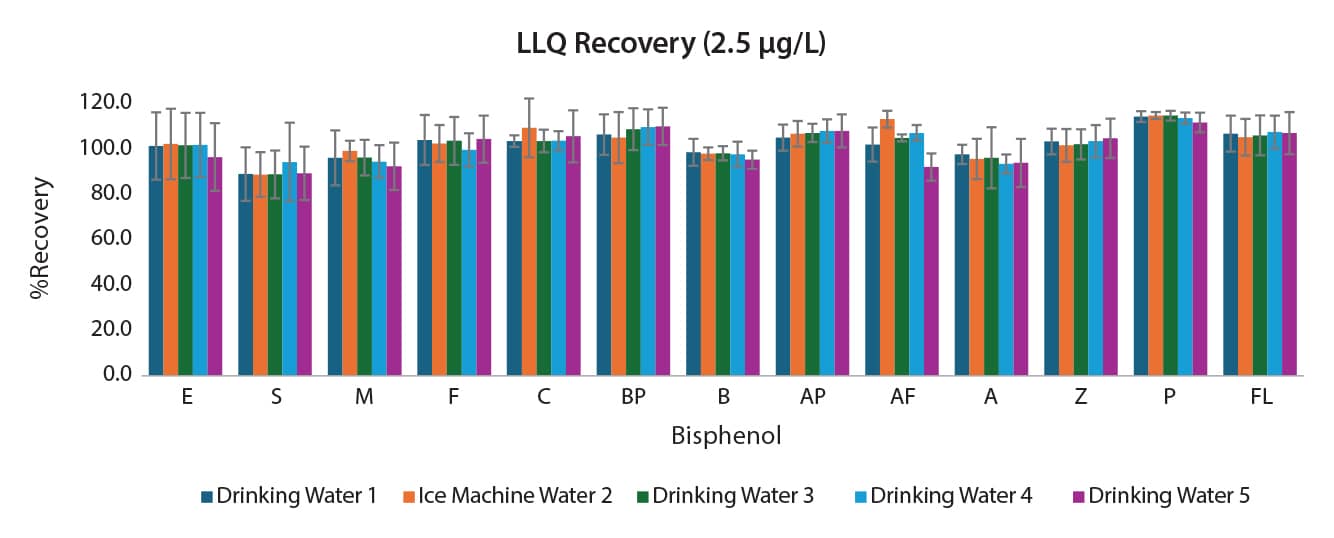
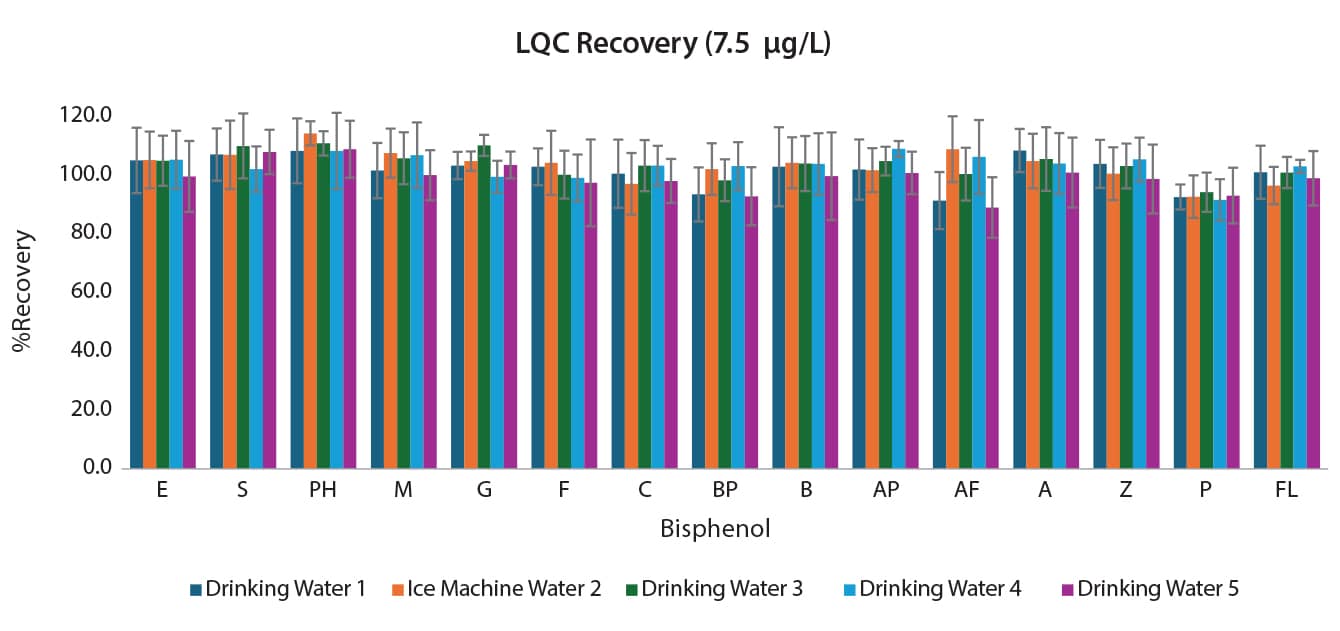
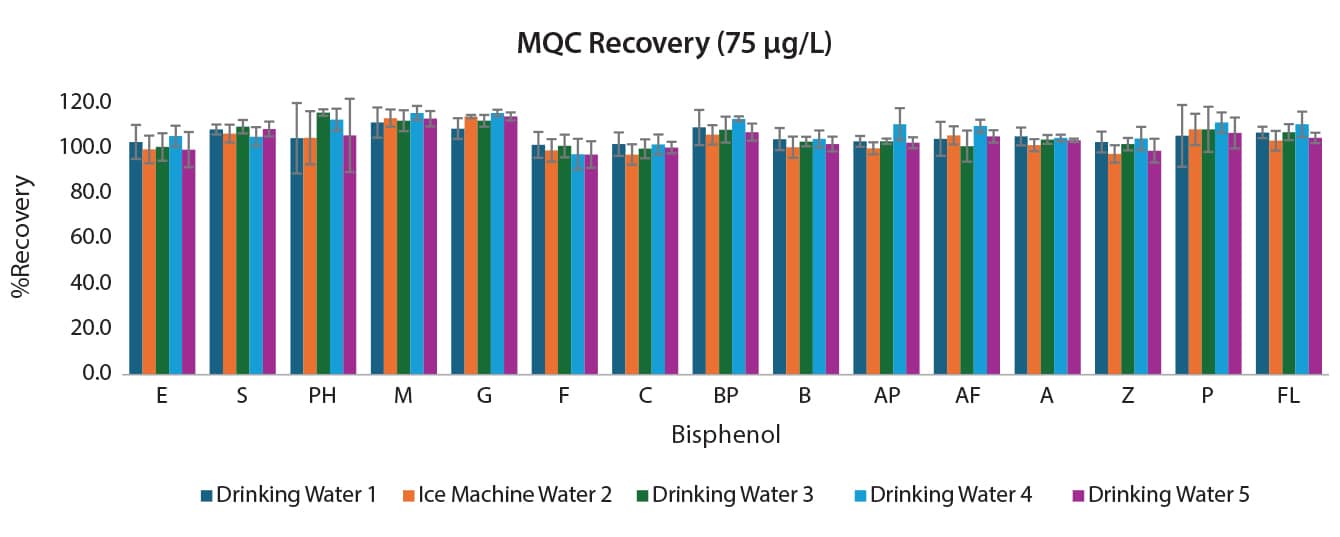
综合方法同样开展了验证和准确度实验。在当地采集的水样中加标 15 种双酚类化合物至 2.5、7.5 和 75 µg/L。在三天内分析了三个批次,共九个平行样。结果见图 3、4 和 5。综合方法的日间回收率为 88.9-115.9%。以相对标准偏差(RSD)百分比衡量的日间精密度 ≤17.3%(n=9)。
结论
本研究开发了两种稳健的 LC-MS/MS 方法用于分析饮用水中的双酚类化合物,两者均获得了良好的定量结果。采用直接进样方式简化了样品前处理,两种互补的分析方法在适合高通量检测的快速分析时间内实现了所有化合物的完全色谱分离。其中一种方法针对 BPA、BPS 和 BPB 的目标物分析进行了优化,因为它们是最常检测的双酚类化合物。另一种方法针对 15 种双酚类化合物进行了优化,以支持希望预先应对法规变化、扩展至更全面目标物清单的实验室。所开发的方法满足欧盟《饮用水指令》中规定的灵敏度要求,为双酚类污染的常规监测提供了切实可行的解决方案。
参考文献
- X. Ye, L. Wong, A.M. Bishop, A.M. Calafat, Variability of urinary concentrations of bisphenol A in spot samples, first morning voids, and 24-hour collections. Environ Health Perspect, 119 (7) (2011) 983–988. https://pubmed.ncbi.nlm.nih.gov/21406337/
- M.E. Cull, L.M. Winn, Bisphenol A and its potential mechanism of action for reproductive toxicity. Toxicology 511 (2025) 154040. https://doi.org/10.1016/j.tox.2024.154040
- State of Californai, OEHHA, Bisphenol S (BPS) Added To Proposition 65 List Following 2023 Meeting of The Developmental and Reproductive Toxicant Identification Committee, January 23, 2014. https://oehha.ca.gov/proposition-65/crnr/bisphenol-s-bps-added-proposition-65-list-following-2023-meeting-developmental-and-reproductive. Accessed June 27, 2025.
- Bisphenol B, an endocrine disruptor for humans and the environment. Anses. September 3, 2021. https://www.anses.fr/en/content/bisphenol-b-endocrine-disruptor-humans-and-environment Accessed June 27, 2015.
- Eur Eau position paper : Bisphenol-A and drinking water. Water News Europe, Press Release, April 28, 2025. https://www.waternewseurope.com/eureau-position-paper-bisphenol-a-and-drinking-water/ Accessed July 28, 2025.