




- Profitieren Sie von einer Deaktivierung der nächsten Generation, die niedrige Nachweisgrenzen ermöglicht und gleichzeitig die gängigen Anforderungen an die Datenqualität zuverlässig erfüllt.
- Ein hochinertes Probenflusskonzept sorgt für scharfe, symmetrische Peaks – auch bei analytisch anspruchsvollen halbflüchtigen Verbindungen.
- Praxiserprobte GC-MS-Bedingungen unterstützen sowohl robuste Scan-Messungen als auch empfindliche SIM-Analysen.


Umweltlabore, die halbflüchtige Verbindungen untersuchen, stehen unter dauerhaftem Handlungsdruck. Kunden erwarten immer niedrigere Nachweisgrenzen. Gleichzeitig sollen der Lösemittelverbrauch und damit verbundene Kosten sinken – sei es aus regulatorischen Gründen oder zur Verbesserung der Wirtschaftlichkeit.
Für diese Aufgaben haben sich MS-basierte GC-Methoden etabliert, etwa die EPA-Methode 8270. Sie bieten die nötige Flexibilität, um die Analytik an die jeweilige Fragestellung anzupassen und möglichst niedrige Nachweisgrenzen zu erreichen. Je nach Ausstattung und Zielsetzung kommen dabei unterschiedliche Strategien zum Einsatz: Einige Labore arbeiten mit besonders empfindlichen Systemen wie GC-MS/MS, andere nutzen GC-MS im Selected-Ion-Monitoring-Modus (SIM). Wieder andere setzen bewusst auf klassische Scan-Messungen, um robuste Routinemethoden zu etablieren.
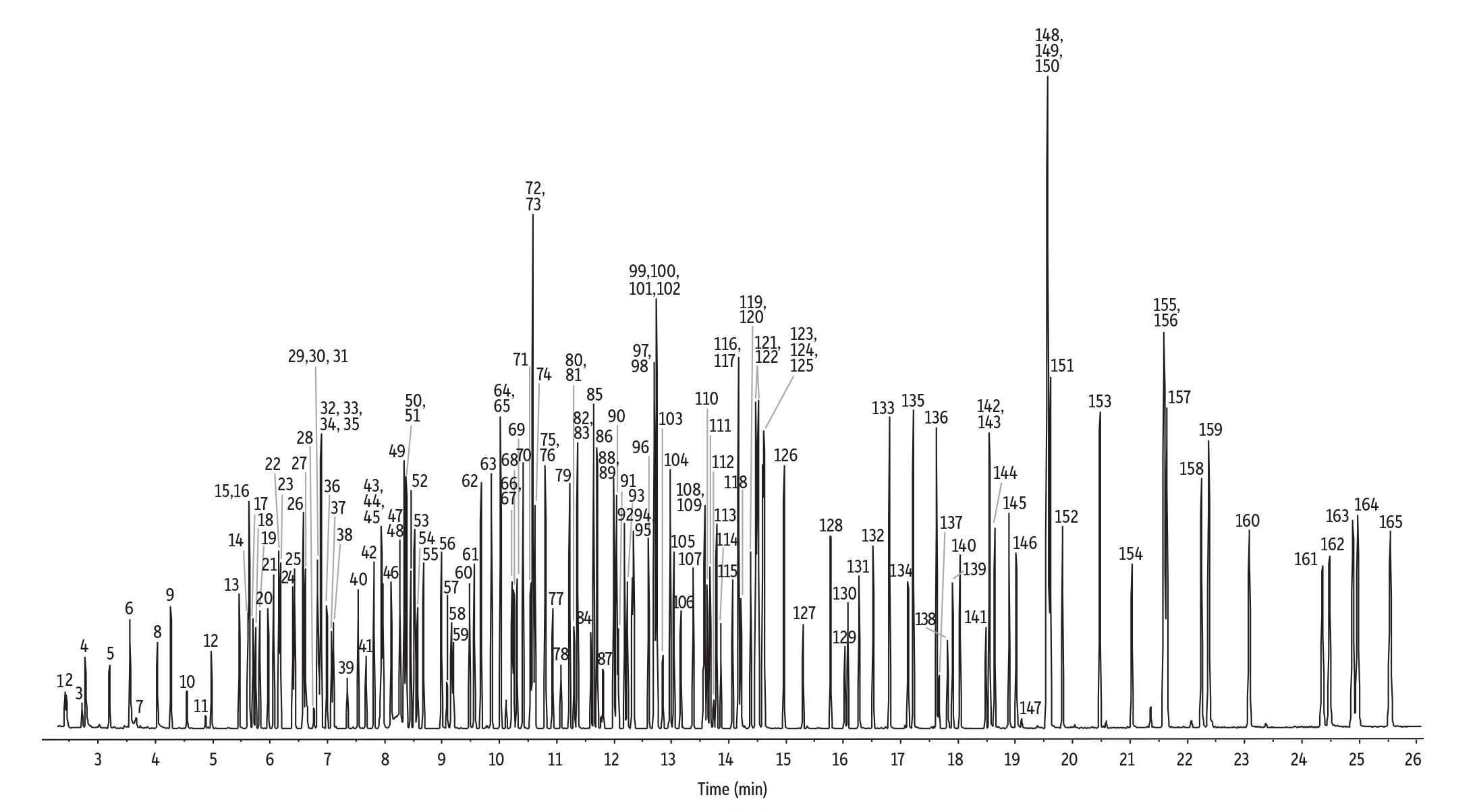
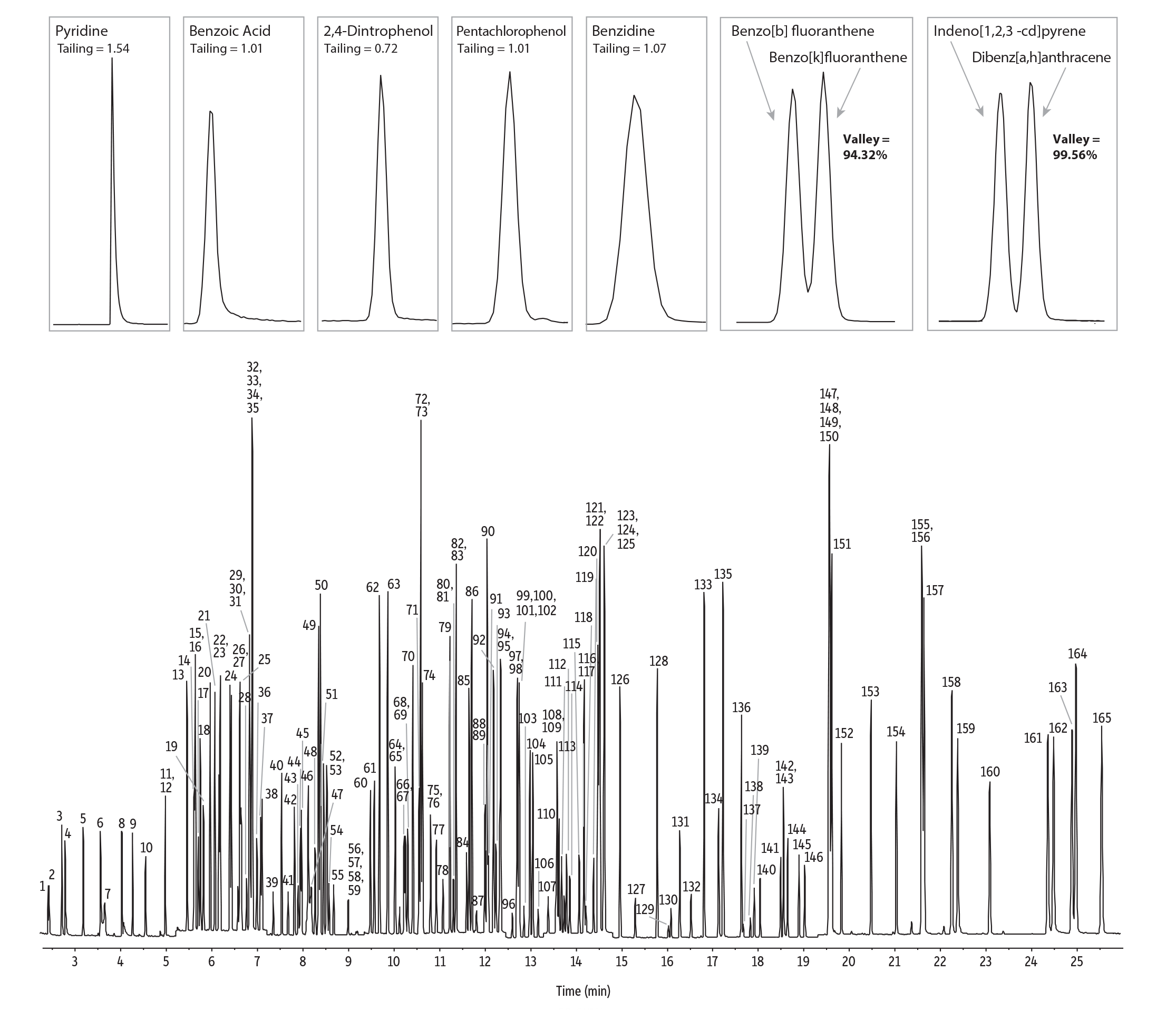
SIM- und Scanmessungen lassen sich in der Regel mit demselben GC-MS-System durchführen. Der Scanmodus ist dabei einfach anzuwenden und vielseitig, da er Signale über einen breiten Massenbereich hinweg erfasst. Der SIM-Modus hingegen konzentriert sich gezielt auf ausgewählte Ionen innerhalb definierter Retentionszeitfenster und ermöglicht dadurch eine deutlich höhere Empfindlichkeit. Der höhere Aufwand bei Einrichtung und Pflege von SIM-Methoden ist bekannt. Dennoch gewinnt dieser Ansatz an Bedeutung, da viele Labore ihre Nachweisgrenzen weiter absenken möchten. GC-MS im SIM-Modus kann hier eine praktikable Alternative zu GC-MS/MS darstellen – insbesondere, weil sich die Empfindlichkeit steigern lässt, ohne in neue Instrumentierung zu investieren. Vor diesem Hintergrund wurden in dieser Studie Bedingungen für die Analyse halbflüchtiger Verbindungen sowohl im Scan- als auch im SIM-Modus etabliert. Ziel war es, Laboren zwei praxistaugliche Optionen an die Hand zu geben: einen robusten und unkomplizierten Scan-Workflow sowie eine hochempfindliche SIM-Variante als Alternative zur GC-MS/MS-Analytik (Abbildung 1).
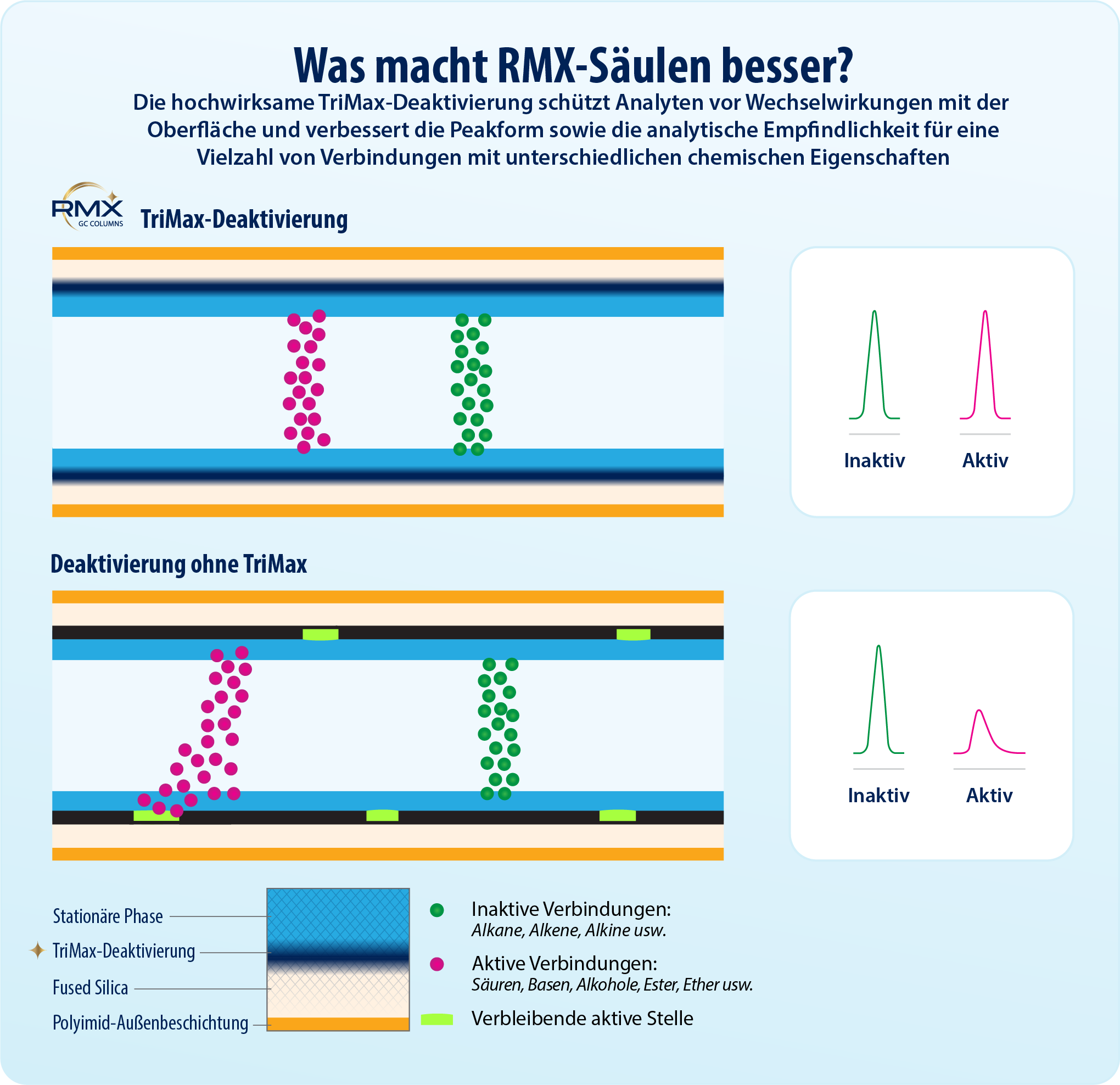
Für beide Ansätze kam eine RMX-5Sil-MS-Säule zum Einsatz, die die bewährte 5sil-Selektivität mit einer TriMax-Deaktivierung der nächsten Generation kombiniert. Diese Oberflächenbehandlung sorgt für einen außergewöhnlich inerten Probenflussweg [1,2]. Entsprechend erfüllte die Peakasymmetrie für zentrale Analyten wie Benzidin, Pentachlorphenol und 2,4-Dinitrophenol durchgängig die Qualitätsanforderungen (≤ 2), wie in Abbildung 1 gezeigt. Auch die Trennleistung für analytisch anspruchsvolle polyzyklische aromatische Kohlenwasserstoffe war überzeugend. Die Auflösungskriterien (> 50 %) wurden problemlos erreicht, mit Talwerten von über 94 % zwischen Benzo[b]- und Benzo[k]fluoranthen sowie über 95 % zwischen Indeno[1,2,3-cd]pyren und Dibenzo[a,h]anthracen.
Unter den hier gewählten Bedingungen erzielte die RMX-5Sil-MS-Säule überzeugende chromatografische Ergebnisse für eine große Bandbreite halbflüchtiger Verbindungen – und das selbst bei sehr niedrigen Einsatzmengen von nur 1 ng im Scan-Modus beziehungsweise 200 pg im SIM-Modus. Die Methode zeigt damit eindrucksvoll, dass sich auch im unteren Bereich der MS-Nachweisgrenzen zuverlässig und mit hoher Datenqualität arbeiten lässt.

Scan-Modus (1 ng on-column)
GC_GN1250
Peaks
Conditions
| Column | RMX-5Sil MS, 30 m, 0.25 mm ID, 0.25 µm (cat.# 17323) |
|---|---|
| Standard/Sample | |
| Methapyrilene (cat.# 32460) | |
| Appendix IX mix #1, revised (cat.# 32459) | |
| SVOC additions (cat.# 31909) | |
| Benzoic acid (cat.# 31879) | |
| 8270 MegaMix (cat.# 31850) | |
| Appendix IX mix #2 (cat.# 31806) | |
| Acid surrogate mix (4/89 SOW) (cat.# 31025) | |
| Base neutral surrogate mix (4/89 SOW) (cat.# 31024) | |
| Revised SV internal standard mix (cat.# 31886) | |
| Diluent: | Methylene chloride |
| Conc.: | 1 µg/mL |
| Injection | |
| Inj. Vol.: | 1 µL split (split ratio 10:1) |
| Liner: | Topaz 4.0 mm ID single taper liner w/wool (cat.# 23303) |
| Inj. Temp.: | 250 °C |
| Split Vent Flow Rate: | 12 mL/min |
| Oven | |
| Oven Temp.: | 40 °C (hold 1 min) to 280 °C at 12.4 °C/min to 330 °C at 3.3 °C/min (hold 3.65 min) |
| Carrier Gas | He, constant flow |
| Flow Rate: | 1.2 mL/min |
| Linear Velocity: | 39.7 cm/sec |
| Detector | MS | ||||||||
|---|---|---|---|---|---|---|---|---|---|
| Mode: | Scan | ||||||||
| Scan Program: | |||||||||
| |||||||||
| Transfer Line Temp.: | 280 °C | ||||||||
| Analyzer Type: | Quadrupole | ||||||||
| Source Temp.: | 330 °C | ||||||||
| Quad Temp.: | 180 °C | ||||||||
| Solvent Delay Time: | 2 min | ||||||||
| Tune Type: | PFTBA | ||||||||
| Ionization Mode: | EI | ||||||||
| Instrument | Agilent 7890B GC & 5977B MSD | ||||||||
| Notes | To simplify ordering, the SVOC MegaMix 150 kit (cat.# 31907) contains one ampul each of the following standards that were used in this experiment. • 8270 MegaMix (cat.# 31850) • SVOC Additions standard (cat.# 31909) • Appendix IX mix #1, revised (cat.# 32459) • Methapyrilene (cat.# 32460) • Appendix IX mix #2 (cat.# 31806) • Benzoic acid (cat.# 31879) | ||||||||
SIM Mode (200 pg on-column)
GC_GN1251
Peaks
| Peaks | tR (min) | Conc. (ng/mL) | SIM Ion | Dwell Time (ms) | Ion Group | |
|---|---|---|---|---|---|---|
| 1. | 1,4-Dioxane-d8 | 2.401 | 200 | 96 | 25 | 1 |
| 2. | 1,4-Dioxane | 2.427 | 200 | 88 | 25 | 1 |
| 3. | N-Nitrosodimethylamine | 2.702 | 200 | 74 | 25 | 1 |
| 4. | Pyridine | 2.774 | 200 | 79 | 25 | 1 |
| 5. | Ethyl methacrylate | 3.175 | 200 | 69 | 25 | 1 |
| 6. | 2-Picoline | 3.554 | 200 | 93 | 25 | 1 |
| 7. | N-Nitrosomethylethylamine | 3.648 | 200 | 42 | 25 | 1 |
| 8. | Methyl methanesulfonate | 4.021 | 200 | 80 | 25 | 1 |
| 9. | 2-Fluorophenol | 4.258 | 200 | 112 | 25 | 1 |
| 10. | Acrylamide | 4.543 | 200 | 71 | 25 | 1 |
| 11. | N-Nitrosodiethylamine | 4.977 | 200 | 102 | 25 | 1 |
| 12. | Ethyl methanesulfonate | 4.977 | 200 | 109 | 25 | 1 |
| 13. | Benzaldehyde | 5.454 | 200 | 77 | 11 | 2 |
| 14. | Phenol-d6 | 5.612 | 200 | 99 | 11 | 2 |
| 15. | Phenol | 5.633 | 200 | 94 | 11 | 2 |
| 16. | Aniline | 5.633 | 200 | 93 | 11 | 2 |
| 17. | Pentachloroethane | 5.7 | 200 | 167 | 11 | 2 |
| 18. | Bis(2-chloroethyl)ether | 5.743 | 200 | 63 | 11 | 2 |
| 19. | 2-Chlorophenol | 5.814 | 200 | 128 | 11 | 2 |
| 20. | n-Decane (C10) | 5.962 | 200 | 57 | 11 | 2 |
| 21. | 1,3-Dichlorobenzene | 6.066 | 200 | 146 | 11 | 2 |
| 22. | 1,4-Dichlorobenzene-d4 | 6.154 | 200 | 150 | 11 | 2 |
| 23. | 1,4-Dichlorobenzene | 6.18 | 200 | 148 | 11 | 2 |
| 24. | Benzyl alcohol | 6.393 | 200 | 79 | 11 | 2 |
| 25. | 1,2-Dichlorobenzene | 6.426 | 200 | 111 | 11 | 2 |
| 26. | 2-Methylphenol (o-cresol) | 6.611 | 200 | 108 | 11 | 2 |
| 27. | 2,2′-Oxybis(1-chloropropane) | 6.634 | 200 | 45 | 11 | 2 |
| 28. | N-Nitrosopyrrolidine | 6.765 | 200 | 100 | 11 | 2 |
| 29. | Acetophenone | 6.825 | 200 | 105 | 11 | 2 |
| 30. | N-Nitrosomorpholine | 6.825 | 200 | 56 | 11 | 2 |
| 31. | N-Nitroso-di-n-propylamine | 6.825 | 200 | 43 | 11 | 2 |
| 32. | 3-Methylphenol (m-cresol) | 6.885 | 200 | 80 | 11 | 2 |
| 33. | 4-Methylphenol (p-cresol) | 6.885 | 200 | 107 | 11 | 2 |
| 34. | Indene | 6.885 | 200 | 117 | 11 | 2 |
| 35. | o-Toluidine | 6.885 | 200 | 106 | 11 | 2 |
| 36. | Hexachloroethane | 6.989 | 200 | 119 | 11 | 2 |
| 37. | Nitrobenzene-d5 | 7.068 | 200 | 82 | 11 | 2 |
| 38. | Nitrobenzene | 7.1 | 200 | 123 | 11 | 2 |
| 39. | N-Nitrosopiperidine | 7.347 | 200 | 114 | 17 | 3 |
| 40. | Isophorone | 7.531 | 200 | 82 | 17 | 3 |
| 41. | 2-Nitrophenol | 7.671 | 200 | 139 | 17 | 3 |
| 42. | 2,4-Dimethylphenol | 7.811 | 200 | 122 | 17 | 3 |
| 43. | Benzoic acid | 7.898 | 200 | 105 | 17 | 3 |
| 44. | O,O,O-Triethyl phosphorothioate | 7.942 | 200 | 121 | 17 | 3 |
| 45. | Bis(2-chloroethoxy)methane | 7.969 | 200 | 93 | 17 | 3 |
| 46. | 2,4-Dichlorophenol | 8.113 | 200 | 162 | 17 | 3 |
| 47. | α,α-Dimethylphenethylamine (phentermine) | 8.178 | 200 | 58 | 17 | 3 |
| 48. | 1,2,4-Trichlorobenzene | 8.264 | 200 | 180 | 17 | 3 |
| 49. | Naphthalene-d8 | 8.34 | 200 | 136 | 17 | 3 |
| 50. | Naphthalene | 8.378 | 200 | 128 | 17 | 3 |
| 51. | α-Terpineol | 8.453 | 200 | 59 | 17 | 3 |
| 52. | 4-Chloroaniline | 8.518 | 200 | 127 | 17 | 3 |
| 53. | 2,6-Dichlorophenol | 8.518 | 200 | 164 | 17 | 3 |
| 54. | Hexachloropropene | 8.572 | 200 | 213 | 17 | 3 |
| 55. | Hexachlorobutadiene | 8.674 | 200 | 225 | 17 | 3 |
| 56. | Quinoline | 8.993 | 200 | 129 | 15 | 4 |
| 57. | ε-Caprolactam | 9.085 | 200 | 55 | 15 | 4 |
| 58. | 1,4-Phenylenediamine | 9.160 | 200 | 108 | 15 | 4 |
| 59. | N-Nitrosodibutylamine | 9.195 | 200 | 84 | 15 | 4 |
| 60. | 4-Chloro-3-methylphenol | 9.477 | 200 | 107 | 15 | 4 |
| 61. | Isosafrole isomer 2 | 9.563 | 200 | 181 | 15 | 4 |
| 62. | 2-Methylnaphthalene | 9.681 | 200 | 142 | 15 | 4 |
| 63. | 1-Methylnaphthalene | 9.858 | 200 | 141 | 15 | 4 |
| 64. | 1,2,4,5-Tetrachlorobenzene | 10.024 | 200 | 216 | 15 | 4 |
| 65. | Hexachlorocyclopentadiene | 10.024 | 200 | 237 | 15 | 4 |
| 66. | 2,3-Dichloroaniline | 10.221 | 200 | 161 | 15 | 4 |
| 67. | Isosafrole isomer 1 | 10.221 | 200 | 104 | 15 | 4 |
| 68. | 2,4,6-Trichlorophenol | 10.25 | 200 | 196 | 15 | 4 |
| 69. | 2,4,5-Trichlorophenol | 10.303 | 200 | 198 | 15 | 4 |
| 70. | 2-Fluorobiphenyl | 10.41 | 200 | 172 | 15 | 4 |
| 71. | Safrole | 10.549 | 200 | 131 | 15 | 4 |
| 72. | Biphenyl | 10.586 | 200 | 154 | 15 | 4 |
| 73. | 2-Chloronaphthalene | 10.586 | 200 | 162 | 15 | 4 |
| 74. | 1-Chloronaphthalene | 10.624 | 200 | 127 | 15 | 4 |
| 75. | 2-Nitroaniline | 10.803 | 200 | 138 | 13 | 5 |
| 76. | Diphenyl ether | 10.803 | 200 | 170 | 15 | 5 |
| 77. | 1,4-Naphthoquinone | 10.927 | 200 | 158 | 13 | 5 |
| 78. | 1,4-Dinitrobenzene | 11.073 | 200 | 168 | 13 | 5 |
| 79. | Dimethylphthalate | 11.223 | 200 | 163 | 13 | 5 |
| 80. | 1,3-Dinitrobenzene | 11.301 | 200 | 76 | 13 | 5 |
| 81. | 2,6-Dinitrotoluene | 11.301 | 200 | 165 | 13 | 5 |
| 82. | 1,2-Dinitrobenzene | 11.363 | 200 | 50 | 13 | 5 |
| Peaks | tR (min) | Conc. (ng/mL) | SIM Ion | Dwell Time (ms) | Ion Group | |
|---|---|---|---|---|---|---|
| 83. | Acenaphthylene | 11.363 | 200 | 152 | 13 | 5 |
| 84. | 3-Nitroaniline | 11.591 | 200 | 65 | 13 | 5 |
| 85. | Acenaphthene-d10 | 11.649 | 200 | 162 | 13 | 5 |
| 86. | Acenaphthene | 11.706 | 200 | 153 | 13 | 5 |
| 87. | 2,4-Dinitrophenol | 11.809 | 200 | 184 | 13 | 5 |
| 88. | 4-Nitrophenol | 11.996 | 200 | 139 | 13 | 5 |
| 89. | Pentachlorobenzene | 11.996 | 200 | 250 | 13 | 5 |
| 90. | Dibenzofuran | 12.043 | 200 | 84 | 13 | 5 |
| 91. | 2,4-Dinitrotoluene | 12.183 | 200 | 89 | 13 | 5 |
| 92. | 1-Naphthylamine (1-aminonaphthalene) | 12.235 | 200 | 143 | 13 | 5 |
| 93. | 2,3,5,6-Tetrachlorophenol | 12.339 | 200 | 232 | 13 | 5 |
| 94. | 2,3,4,6-Tetrachlorophenol | 12.339 | 200 | 230 | 13 | 5 |
| 95. | 2-Naphthylamine (2-aminonaphthalene) | 12.339 | 200 | 115 | 13 | 5 |
| 96. | Diethylphthalate | 12.596 | 200 | 149 | 13 | 5 |
| 97. | n-Hexadecane (C16) | 12.703 | 200 | 57 | 29 | 6 |
| 98. | Fluorene | 12.703 | 200 | 166 | 29 | 6 |
| 99. | Zalophus (thionazine) | 12.746 | 200 | 107 | 29 | 6 |
| 100. | 4-Chlorophenyl phenyl ether | 12.746 | 200 | 204 | 29 | 6 |
| 101. | 4-Nitroaniline | 12.746 | 200 | 65 | 29 | 6 |
| 102. | 5-Nitro-o-toluidine | 12.746 | 200 | 152 | 29 | 6 |
| 103. | 4,6-Dinitro-2-methylphenol (Dinitro-o-cresol) | 12.852 | 200 | 198 | 29 | 6 |
| 104. | Diphenylamine† | 12.98 | 200 | 169 | 29 | 6 |
| 105. | Azobenzene* | 13.044 | 200 | 77 | 29 | 6 |
| 106. | 2,4,6-Tribromophenol | 13.162 | 200 | 330 | 29 | 6 |
| 107. | Sulfotepp | 13.385 | 200 | 322 | 14 | 7 |
| 108. | 1,3,5-Trinitrobenzene | 13.581 | 200 | 213 | 14 | 7 |
| 109. | Phenacetin | 13.581 | 200 | 108 | 14 | 7 |
| 110. | Phorate | 13.618 | 200 | 75 | 14 | 7 |
| 111. | 4-Bromophenyl phenyl ether | 13.677 | 200 | 248 | 14 | 7 |
| 112. | Diallate | 13.735 | 200 | 43 | 14 | 7 |
| 113. | Hexachlorobenzene | 13.788 | 200 | 284 | 14 | 7 |
| 114. | Dimethoate | 13.857 | 200 | 87 | 14 | 7 |
| 115. | Atrazine | 14.064 | 200 | 200 | 14 | 7 |
| 116. | 4-Aminobiphenyl | 14.17 | 200 | 169 | 14 | 7 |
| 117. | Pentachlorophenol | 14.17 | 200 | 266 | 14 | 7 |
| 118. | Pentachloronitrobenzene (Quintozene) | 14.213 | 200 | 237 | 14 | 7 |
| 119. | Propyzamide | 14.377 | 200 | 173 | 14 | 7 |
| 120. | Phenanthrene-d10 | 14.477 | 200 | 188 | 14 | 7 |
| 121. | n-Octadecane (C18) | 14.52 | 200 | 57 | 14 | 7 |
| 122. | Phenanthrene | 14.52 | 200 | 178 | 14 | 7 |
| 123. | Dinoseb | 14.616 | 200 | 211 | 14 | 7 |
| 124. | Disulfoton | 14.616 | 200 | 88 | 14 | 7 |
| 125. | Anthracene | 14.616 | 200 | 179 | 14 | 7 |
| 126. | Carbazole | 14.961 | 200 | 167 | 30 | 8 |
| 127. | Methyl parathion | 15.296 | 200 | 109 | 30 | 8 |
| 128. | Di-n-butyl phthalate | 15.779 | 200 | 149 | 30 | 8 |
| 129. | 4-Nitroquinoline-N-oxide | 16.026 | 200 | 190 | 30 | 8 |
| 130. | Parathion (ethyl parathion) | 16.075 | 200 | 291 | 30 | 8 |
| 131. | Methapyrilene hydrochloride | 16.273 | 200 | 58 | 30 | 8 |
| 132. | Isodrin | 16.52 | 200 | 193 | 30 | 8 |
| 133. | Fluoranthene | 16.806 | 200 | 202 | 30 | 8 |
| 134. | Benzidine | 17.124 | 200 | 184 | 30 | 8 |
| 135. | Pyrene | 17.223 | 200 | 203 | 30 | 8 |
| 136. | p-Terphenyl-d14 | 17.627 | 200 | 244 | 27 | 9 |
| 137. | Aramite isomer 2 | 17.627 | 200 | 175 | 27 | 9 |
| 138. | Aramite isomer 1 | 17.818 | 200 | 135 | 27 | 9 |
| 139. | p-Dimethylaminoazobenzene | 17.905 | 200 | 120 | 27 | 9 |
| 140. | Chlorobenzilate | 18.041 | 200 | 251 | 27 | 9 |
| 141. | Famphur | 18.487 | 200 | 218 | 27 | 9 |
| 142. | 3,3′-Dimethylbenzidine (o-tolidine) | 18.553 | 200 | 254 | 15 | 9 |
| 143. | Kepone | 18.553 | 200 | 272 | 27 | 9 |
| 144. | Benzyl butyl phthalate | 18.64 | 200 | 149 | 27 | 9 |
| 145. | Bis(2-ethylhexyl)adipate | 18.89 | 200 | 129 | 27 | 9 |
| 146. | 2-Acetylaminofluorene | 19.015 | 200 | 181 | 27 | 9 |
| 147. | 4,4′-Methylene-bis(2-chloroaniline) | 19.561 | 200 | 231 | 15 | 9 |
| 148. | 3,3′-Dichlorobenzidine | 19.561 | 200 | 212 | 27 | 9 |
| 149. | Benz[a]anthracene | 19.561 | 200 | 228 | 15 | 10 |
| 150. | Chrysene-d12 | 19.561 | 200 | 240 | 15 | 10 |
| 151. | Chrysene | 19.61 | 200 | 226 | 15 | 10 |
| 152. | Bis(2-ethylhexyl)phthalate | 19.824 | 200 | 167 | 15 | 10 |
| 153. | 6-Methylchrysene | 20.473 | 200 | 242 | 15 | 10 |
| 154. | Di-n-octyl phthalate | 21.031 | 200 | 149 | 15 | 10 |
| 155. | Benzo[b]fluoranthene | 21.589 | 200 | 57 | 15 | 10 |
| 156. | 7,12-Dimethylbenz[a]anthracene | 21.589 | 200 | 256 | 15 | 10 |
| 157. | Benzo[k]fluoranthene | 21.637 | 200 | 252 | 15 | 10 |
| 158. | Benzo[a]pyrene | 22.249 | 200 | 253 | 15 | 10 |
| 159. | Perylene-d12 | 22.377 | 200 | 264 | 15 | 10 |
| 160. | 3-Methylcholanthrene | 23.08 | 200 | 268 | 15 | 10 |
| 161. | Dibenz(a,h)acridine | 24.357 | 200 | 279 | 15 | 10 |
| 162. | Dibenz[a,j]acridine | 24.48 | 200 | 280 | 15 | 10 |
| 163. | Indeno[1,2,3-cd]pyrene | 24.882 | 200 | 277 | 15 | 10 |
| 164. | Dibenz[a,h]anthracene | 24.968 | 200 | 278 | 15 | 10 |
| 165. | Benzo[g,h,i]perylene | 25.537 | 200 | 276 | 15 | 10 |
Conditions
| Column | RMX-5Sil MS, 30 m, 0.25 mm ID, 0.25 µm (cat.# 17323) |
|---|---|
| Standard/Sample | |
| Methapyrilene (cat.# 32460) | |
| Appendix IX mix #1, revised (cat.# 32459) | |
| SVOC additions (cat.# 31909) | |
| Benzoic acid (cat.# 31879) | |
| 8270 MegaMix (cat.# 31850) | |
| Appendix IX mix #2 (cat.# 31806) | |
| Acid surrogate mix (4/89 SOW) (cat.# 31025) | |
| Base neutral surrogate mix (4/89 SOW) (cat.# 31024) | |
| Revised SV internal standard mix (cat.# 31886) | |
| Diluent: | Methylene chloride |
| Conc.: | 200 ng/mL |
| Injection | |
| Inj. Vol.: | 1 µL split (split ratio 10:1) |
| Liner: | Topaz 4.0 mm ID single taper liner w/wool (cat.# 23303) |
| Inj. Temp.: | 250 °C |
| Split Vent Flow Rate: | 12 mL/min |
| Oven | |
| Oven Temp.: | 40 °C (hold 1 min) to 280 °C at 12.4 °C/min to 330 °C at 3.3 °C/min (hold 3.65 min) |
| Carrier Gas | He, constant flow |
| Flow Rate: | 1.2 mL/min |
| Linear Velocity: | 39.7 cm/sec |
| Detector | MS | ||||||||||||||||||||||||||||||||||||||||||||
|---|---|---|---|---|---|---|---|---|---|---|---|---|---|---|---|---|---|---|---|---|---|---|---|---|---|---|---|---|---|---|---|---|---|---|---|---|---|---|---|---|---|---|---|---|---|
| Mode: | SIM | ||||||||||||||||||||||||||||||||||||||||||||
| SIM Program: | |||||||||||||||||||||||||||||||||||||||||||||
| |||||||||||||||||||||||||||||||||||||||||||||
| Transfer Line Temp.: | 280 °C | ||||||||||||||||||||||||||||||||||||||||||||
| Analyzer Type: | Quadrupole | ||||||||||||||||||||||||||||||||||||||||||||
| Source Temp.: | 330 °C | ||||||||||||||||||||||||||||||||||||||||||||
| Quad Temp.: | 180 °C | ||||||||||||||||||||||||||||||||||||||||||||
| Solvent Delay Time: | 2 min | ||||||||||||||||||||||||||||||||||||||||||||
| Tune Type: | PFTBA | ||||||||||||||||||||||||||||||||||||||||||||
| Ionization Mode: | EI | ||||||||||||||||||||||||||||||||||||||||||||
| Instrument | Agilent 7890B GC & 5977B MSD | ||||||||||||||||||||||||||||||||||||||||||||
| Notes | To simplify ordering, the SVOC MegaMix 150 kit (cat.# 31907) contains one ampul each of the following standards that were used in this experiment. • 8270 MegaMix (cat.# 31850) • SVOC Additions standard (cat.# 31909) • Appendix IX mix #1, revised (cat.# 32459) • Methapyrilene (cat.# 32460) • Appendix IX mix #2 (cat.# 31806) • Benzoic acid (cat.# 31879) | ||||||||||||||||||||||||||||||||||||||||||||
Literaturhinweise
- E. Pack, J. Hoisington, C. English, R. Dhandapani, and C. Myers, Comprehensive trace-level semivolatiles analysis by GC-MS/MS (EPA Method 8270E), Application note, EVAN4919-US, Restek Corporation, 2025. https://discover.restek.com/application-notes/evan4919/comprehensive-trace-level-gc-ms-ms-semivolatiles-method-epa-method-8270e
- Broschüre zu RMX GC Säulen, GNBR4923-UNV, Restek Corporation, 2026. https://discover.restek.com/articles/gnbr4923/rmx-gc-columns-unleash-your-performance

Vorgestellte Produkte
Autoren