

- 独自の固定相は、短鎖および長鎖PFASと同様に、極性で小さな超短鎖PFASに適切なクロマトグラフィー保持をもたらします。
- 高速でシンプルなイソクラティックLC‐MS/MS法は、ハイスループットPFAS分析を可能にします。
- 一貫したカラム性能により、正確な結果が保証されます。
ペルフルオロアルキルおよびポリフルオロアルキル化合物(PFAS)分析のための現在のLC‐MS/MS法は、短鎖(C4~C6)、長鎖(C8以上)、および代替化合物に焦点を当てており、新しいトレンド傾向にある超短鎖(C2およびC3)化合物を含みません。超短鎖PFASは、環境水(例えば、雨水、河川、および地下水)中に遍在しており、水サンプル中の全PFASの少なくとも40%であると報告されているため、重要性が増しています。超短鎖PFASは、トリフルオロ酢酸(TFA)、ペルフルオロプロパン酸(PFPrA)、ペルフルオロエタンスルホン酸塩(PFEtS)、およびペルフルオロプロパンスルホン酸塩(PFPrS)を含み、TFAが最も多く、分析が最も困難なものの1つでもあります。超短鎖化合物(TFAを含む)ならびに代替およびレガシーPFASについて、信頼できる結果をもたらす真の包括的PFAS分析法は、水のモニタリングプログラムに必須です。
TFA分析で遭遇する重大な課題は、逆相カラムおよびHILICカラムでは保持が弱い、もしくはほとんど保持されないことです。強力なイオン交換メカニズムを示す他のカラムは、反対の問題、すなわち、強すぎる保持とピーク形状の悪さを示す可能性があります。対照的に、TFAは、Raptor Polar Xカラムで確実に保持および分析することができます。これは、Raptor Polar XカラムがHILICおよびイオン交換保持機構を合わせ持つ独特のハイブリッドリガンドを有するためです。ここで実証したように、C2、C3、C4、C6、C8、および代替PFASを含む包括的PFAS分析のための迅速かつシンプルなLC‐MS/MS法が確立されました。さらに長鎖のPFASも可能です。この方法は、飲料水および非飲料水の両方の分析に適用することができ、現在のPFASアッセイに超短鎖化合物を追加することに関心のあるラボへ、便利な設定とハイスループットを提供します。
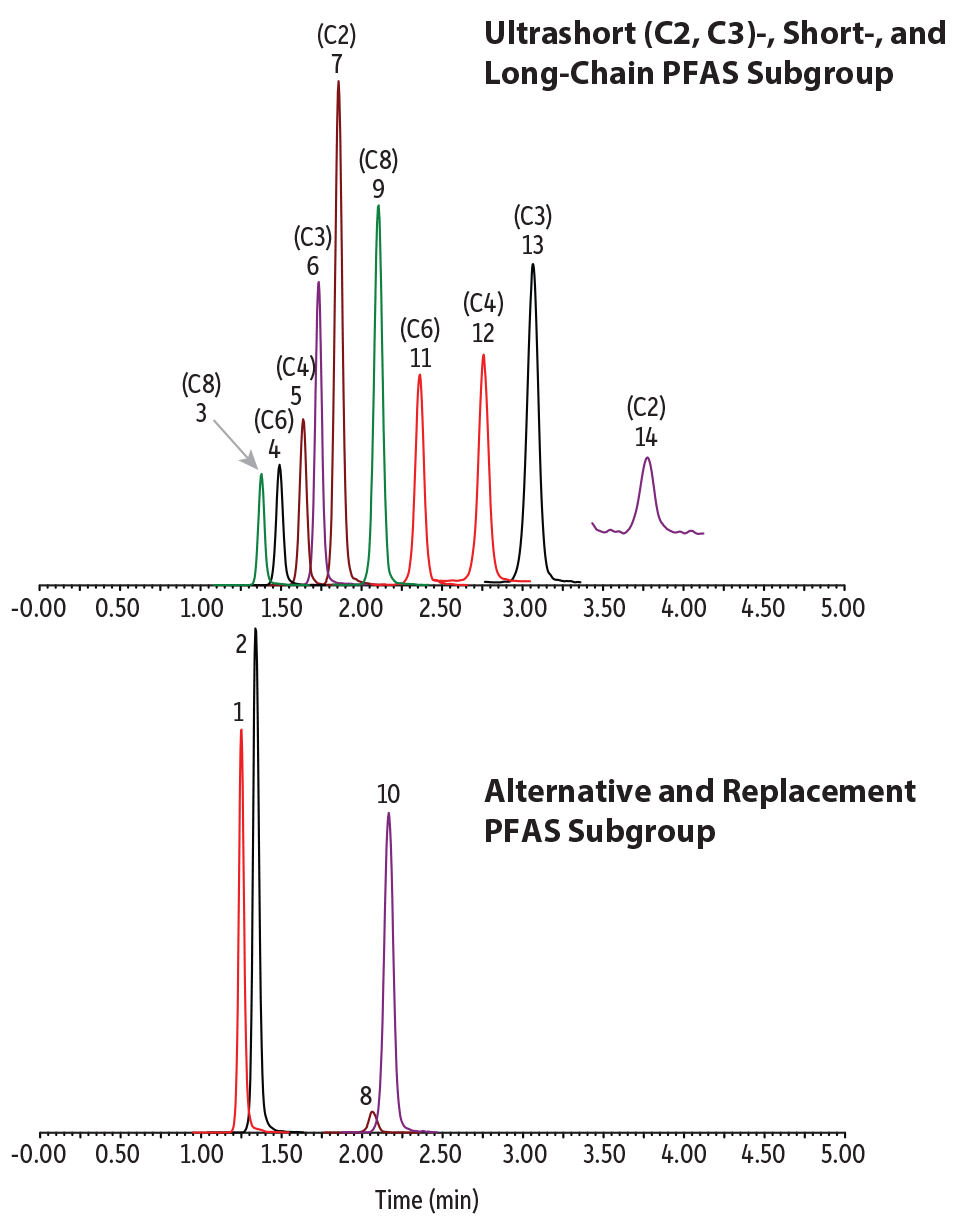
LC_EV0569
Peaks
| Peaks | tR (min) | Conc. (ng/L) | Precursor Ion | Product Ion | |
|---|---|---|---|---|---|
| 1. | 11-Chloroeicosafluoro-3-oxanonane-1-sulfonate (11CL-PF3OUdS) | 1.25 | 400 | 630.78 | 450.80 |
| 2. | 9-Chlorohexadecafluoro-3-oxanonane-1-sulfonate (9Cl-PF3ONS) | 1.34 | 400 | 530.78 | 350.85 |
| 3. | Perfluorooctanesulfonic acid (PFOS) | 1.38 | 400 | 498.84 | 79.97 |
| 4. | Perfluorohexanesulfonic acid (PFHxS) | 1.49 | 400 | 398.90 | 79.97 |
| 5. | Perfluorobutanesulfonic acid (PFBS) | 1.64 | 400 | 298.97 | 79.97 |
| 6. | Perfluoropropanesulfonic acid (PFPrS) | 1.73 | 400 | 248.97 | 79.98 |
| 7. | Perfluoroethanesulfonic acid (PFEtS) | 1.86 | 400 | 198.98 | 79.92 |
| Peaks | tR (min) | Conc. (ng/L) | Precursor Ion | Product Ion | |
|---|---|---|---|---|---|
| 8. | Hexafluoropropylene oxide dimer acid (HFPO-DA) | 2.06 | 400 | 284.97 | 168.92 |
| 9. | Perfluorooctanoic acid (PFOA) | 2.11 | 400 | 412.90 | 368.91 |
| 10. | Ammonium 4,8-dioxa-3H-perfluorononanoate (ADONA) | 2.15 | 400 | 376.90 | 250.93 |
| 11. | Perfluorohexanoic acid (PFHxA) | 2.36 | 400 | 312.97 | 268.90 |
| 12. | Perfluorobutanoic acid (PFBA) | 2.76 | 400 | 212.97 | 168.97 |
| 13. | Perfluoropropionic acid (PFPrA) | 3.06 | 400 | 163.03 | 119.01 |
| 14. | Trifluoroacetic acid (TFA) | 3.77 | 400 | 113.03 | 69.01 |
Conditions
| Column | Raptor Polar X (cat.# 9311A52) | ||||||||||||
|---|---|---|---|---|---|---|---|---|---|---|---|---|---|
| Dimensions: | 50 mm x 2.1 mm ID | ||||||||||||
| Particle Size: | 2.7 µm | ||||||||||||
| Temp.: | 40 °C | ||||||||||||
| Standard/Sample | |||||||||||||
| Diluent: | 50:50 Water:methanol | ||||||||||||
| Conc.: | 400 ng/L | ||||||||||||
| Inj. Vol.: | 10 µL | ||||||||||||
| Mobile Phase | |||||||||||||
| A: | Water, 10 mM ammonium formate, 0.05% formic acid | ||||||||||||
| B: | 60:40 Acetonitrile:methanol, 0.05% formic acid | ||||||||||||
|
| Detector | MS/MS |
|---|---|
| Ion Mode: | ESI- |
| Mode: | MRM |
| Instrument | UHPLC |
| Notes | To achieve more stable and robust performance with Polar X columns, the recommended LC conditions have changed from those that were used here. The new recommended conditions are an aqueous mobile phase (mobile phase A) consisting of 5 mM or 10 mM ammonium formate with 0.1% formic acid in water and an organic mobile phase (mobile phase B) of 100% acetonitrile. Higher ammonium formate concentrations will result in reduced analyte retention. Therefore, laboratories can optimize retention by adjusting both the ammonium formate concentration and the flow rate to best meet their analytical requirements. In addition, it is recommended that labs evaluate different isocratic conditions by varying the amount of mobile phase B between 70% and 85% acetonitrile. This approach can help labs identify the most suitable separation conditions for their specific target analytes and sample matrices of interest. |