


- Unique stationary phase provides proper chromatographic retention of small, polar ultrashort-chain PFAS as well as short- and long-chain PFAS.
- Fast and simple isocratic LC-MS/MS method allows high-throughput PFAS analysis.
- Consistent column performance ensures accurate results.
Current LC-MS/MS methods for per- and polyfluoroalkyl substances (PFAS) analysis are focused on short-chain (C4-C6), long-chain (C8 and up), and alternative or replacement compounds and do not include newly trending ultrashort-chain (C2 and C3) compounds. The ultrashort-chain PFAS are growing in importance because they are ubiquitous in environmental waters (e.g., rain, river, and groundwaters) and have been reported as being at least 40% of the total PFAS in water samples. Ultrashort-chain PFAS include trifluoroacetic acid (TFA), perfluoropropanoic acid (PFPrA), perfluoroethane sulfonate (PFEtS), and perfluoropropane sulfonate (PFPrS), with TFA being the most abundant as well as one of the most difficult to analyze. True comprehensive PFAS analysis methods that provide reliable results for ultrashort-chain compounds (including TFA) as well as alternative and legacy PFAS are essential for water monitoring programs.
The critical challenge encountered with TFA analysis is that it exhibits limited retention and/or poor chromatography on reversed-phase columns and HILIC columns. Other columns that emphasize strong ion-exchange mechanisms can pose the opposite problem: too much retention and poor peak shapes. In contrast, TFA can be reliably retained and analyzed on Raptor Polar X columns because they contain a unique hybrid ligand that blends HILIC and ion-exchange retention mechanisms. As demonstrated here, a fast and simple LC-MS/MS method was established for comprehensive PFAS analysis that includes C2, C3, C4, C6, C8, and alternative PFAS. Even longer-chain PFAS are possible, too. This method can be applied to both potable and non-potable water analysis and provides convenient setup and high throughput for labs interested in adding ultrashort-chain compounds to an existing PFAS assay.
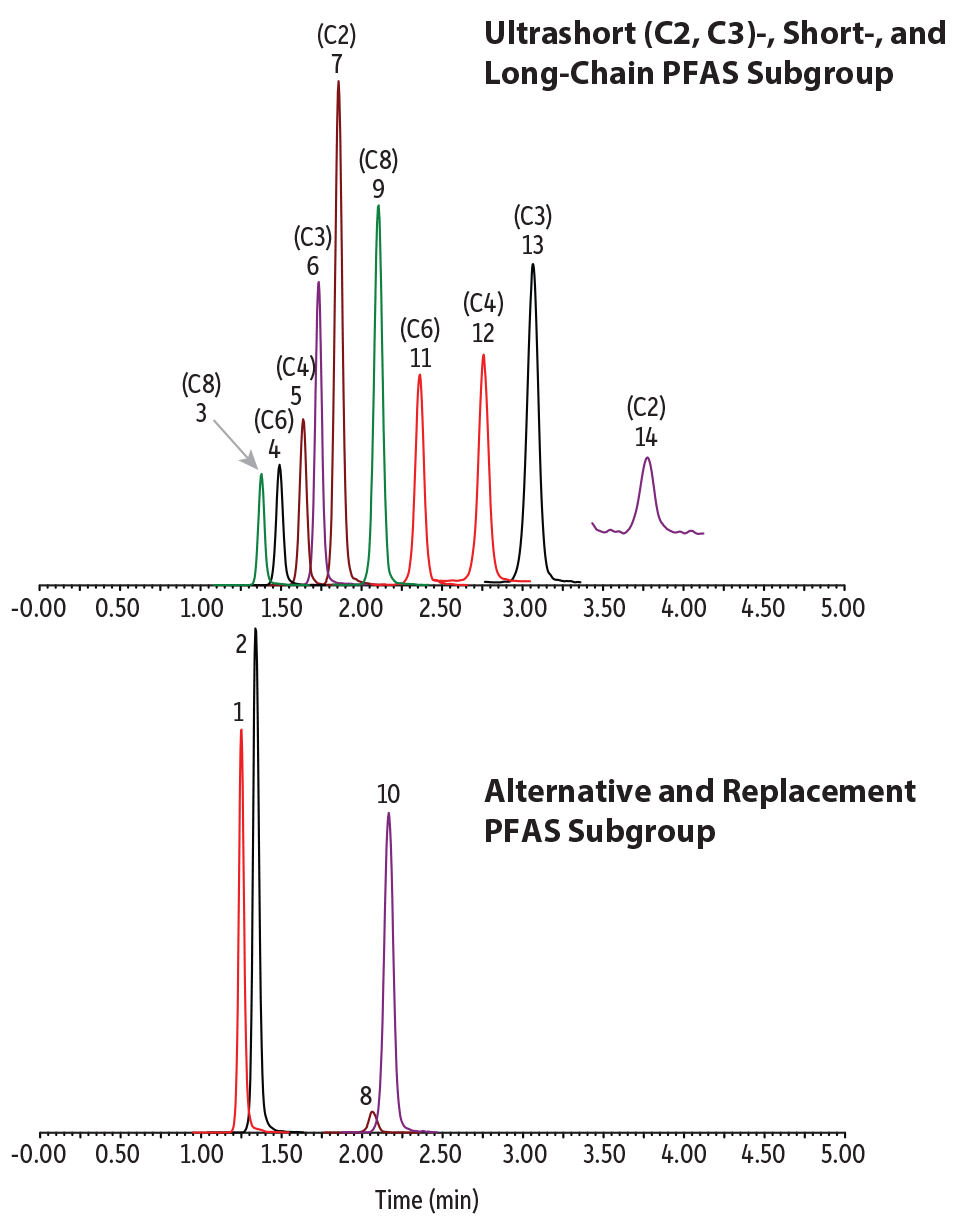
LC_EV0569
Peaks
| Peaks | tR (min) | Conc. (ng/L) | Precursor Ion | Product Ion | |
|---|---|---|---|---|---|
| 1. | 11-Chloroeicosafluoro-3-oxanonane-1-sulfonate (11CL-PF3OUdS) | 1.25 | 400 | 630.78 | 450.80 |
| 2. | 9-Chlorohexadecafluoro-3-oxanonane-1-sulfonate (9Cl-PF3ONS) | 1.34 | 400 | 530.78 | 350.85 |
| 3. | Perfluorooctanesulfonic acid (PFOS) | 1.38 | 400 | 498.84 | 79.97 |
| 4. | Perfluorohexanesulfonic acid (PFHxS) | 1.49 | 400 | 398.90 | 79.97 |
| 5. | Perfluorobutanesulfonic acid (PFBS) | 1.64 | 400 | 298.97 | 79.97 |
| 6. | Perfluoropropanesulfonic acid (PFPrS) | 1.73 | 400 | 248.97 | 79.98 |
| 7. | Perfluoroethanesulfonic acid (PFEtS) | 1.86 | 400 | 198.98 | 79.92 |
| Peaks | tR (min) | Conc. (ng/L) | Precursor Ion | Product Ion | |
|---|---|---|---|---|---|
| 8. | Hexafluoropropylene oxide dimer acid (HFPO-DA) | 2.06 | 400 | 284.97 | 168.92 |
| 9. | Perfluorooctanoic acid (PFOA) | 2.11 | 400 | 412.90 | 368.91 |
| 10. | Ammonium 4,8-dioxa-3H-perfluorononanoate (ADONA) | 2.15 | 400 | 376.90 | 250.93 |
| 11. | Perfluorohexanoic acid (PFHxA) | 2.36 | 400 | 312.97 | 268.90 |
| 12. | Perfluorobutanoic acid (PFBA) | 2.76 | 400 | 212.97 | 168.97 |
| 13. | Perfluoropropionic acid (PFPrA) | 3.06 | 400 | 163.03 | 119.01 |
| 14. | Trifluoroacetic acid (TFA) | 3.77 | 400 | 113.03 | 69.01 |
Conditions
| Column | Raptor Polar X (cat.# 9311A52) | ||||||||||||
|---|---|---|---|---|---|---|---|---|---|---|---|---|---|
| Dimensions: | 50 mm x 2.1 mm ID | ||||||||||||
| Particle Size: | 2.7 µm | ||||||||||||
| Temp.: | 40 °C | ||||||||||||
| Standard/Sample | |||||||||||||
| Diluent: | 50:50 Water:methanol | ||||||||||||
| Conc.: | 400 ng/L | ||||||||||||
| Inj. Vol.: | 10 µL | ||||||||||||
| Mobile Phase | |||||||||||||
| A: | Water, 10 mM ammonium formate, 0.05% formic acid | ||||||||||||
| B: | 60:40 Acetonitrile:methanol, 0.05% formic acid | ||||||||||||
|
| Detector | MS/MS |
|---|---|
| Ion Mode: | ESI- |
| Mode: | MRM |
| Instrument | UHPLC |
| Notes | To achieve more stable and robust performance with Polar X columns, the recommended LC conditions have changed from those that were used here. The new recommended conditions are an aqueous mobile phase (mobile phase A) consisting of 5 mM or 10 mM ammonium formate with 0.1% formic acid in water and an organic mobile phase (mobile phase B) of 100% acetonitrile. Higher ammonium formate concentrations will result in reduced analyte retention. Therefore, laboratories can optimize retention by adjusting both the ammonium formate concentration and the flow rate to best meet their analytical requirements. In addition, it is recommended that labs evaluate different isocratic conditions by varying the amount of mobile phase B between 70% and 85% acetonitrile. This approach can help labs identify the most suitable separation conditions for their specific target analytes and sample matrices of interest. |

您的PFAS分析需要帮助吗?
从方法选择到产品推荐,Restek PFAS 专家助您应对复杂分析流程,获得准确、可靠的分析结果。